# Allocating Value from Outsourced Grid Flexibility

An Electricity Network Board Decision on Verified Delivery

Author: Phil Hatch
Publisher: Akholi
Paper ID: AAO-108
Published: October 23, 2026
Language: en
Canonical: https://akholi.com/papers/allocating-value-from-outsourced-grid-flexibility/
Audience: Utility board, CEO, CFO, chief customer officer

Electricity-network executives should link supplier value and payment to verified flexibility under the applicable market method. AI-optimized dispatch, modeled savings, delivered response, and net network value are different claims that require separate evidence.

<h2 id="section-1">Define the Network Result Being Purchased</h2>
<p>The board should ask management which service the provider supplies: availability, dispatch optimization, verified response, capacity, or another contracted function. An agent’s recommendation or issued instruction should not be treated as delivered flexibility without the relevant metering and settlement evidence.</p>
<p>Elexon’s Flexibility Market Rules specify verification <a href="https://rulebook.elexon.co.uk/flex-market/documents/fmr-vsm-verification-settlement-methodology">and settlement methods within the relevant DNO sub-market scope.</a><sup id="ref-1"><a href="#note-1" aria-label="Note 1">1</a></sup> The rules include scope and derogation provisions; they are not one global flexibility-market standard. Management should establish the current applicable market and contract method.</p>
<p>For a hypothetical dispatch, an agent may select a lower-cost resource while the measured response differs from the plan. The executive should distinguish the quality of the optimization from the value of the actual delivery and any residual network requirement.</p>
<h2 id="section-2">Preserve the Baseline and the Measurement Boundary</h2>
<p>A claimed reduction depends on the agreed counterfactual and measurement method. Record the baseline, metering source, asset population, time window, adjustments, and approved exclusions. A changed baseline can alter apparent performance without changing physical delivery.</p>
<p>The <a href="https://akholi.com/outsourcing-2026-agentic-ai-tier-1-banks/part-5-manual-alteration/">study</a> reports <a href="https://akholi.com/outsourcing-2026-agentic-ai-tier-1-banks/part-3-governance-oversight-control/">manual alteration and incomplete downstream mapping in banking engagements.</a><sup id="ref-2"><a href="#note-2" aria-label="Note 2">2</a></sup> It does not establish grid performance or baseline manipulation. The transferable concern is whether the buyer can see material changes and verify the result across the supplier chain.</p>
<p>Preserve human changes to dispatch, asset availability, and performance classification. Some interventions are necessary engineering judgment. They should remain visible in the operating and commercial record rather than disappear behind a claim that the agent delivered the result autonomously.</p>
<h2 id="section-3">Use a Flexibility Value Allocation Record</h2>
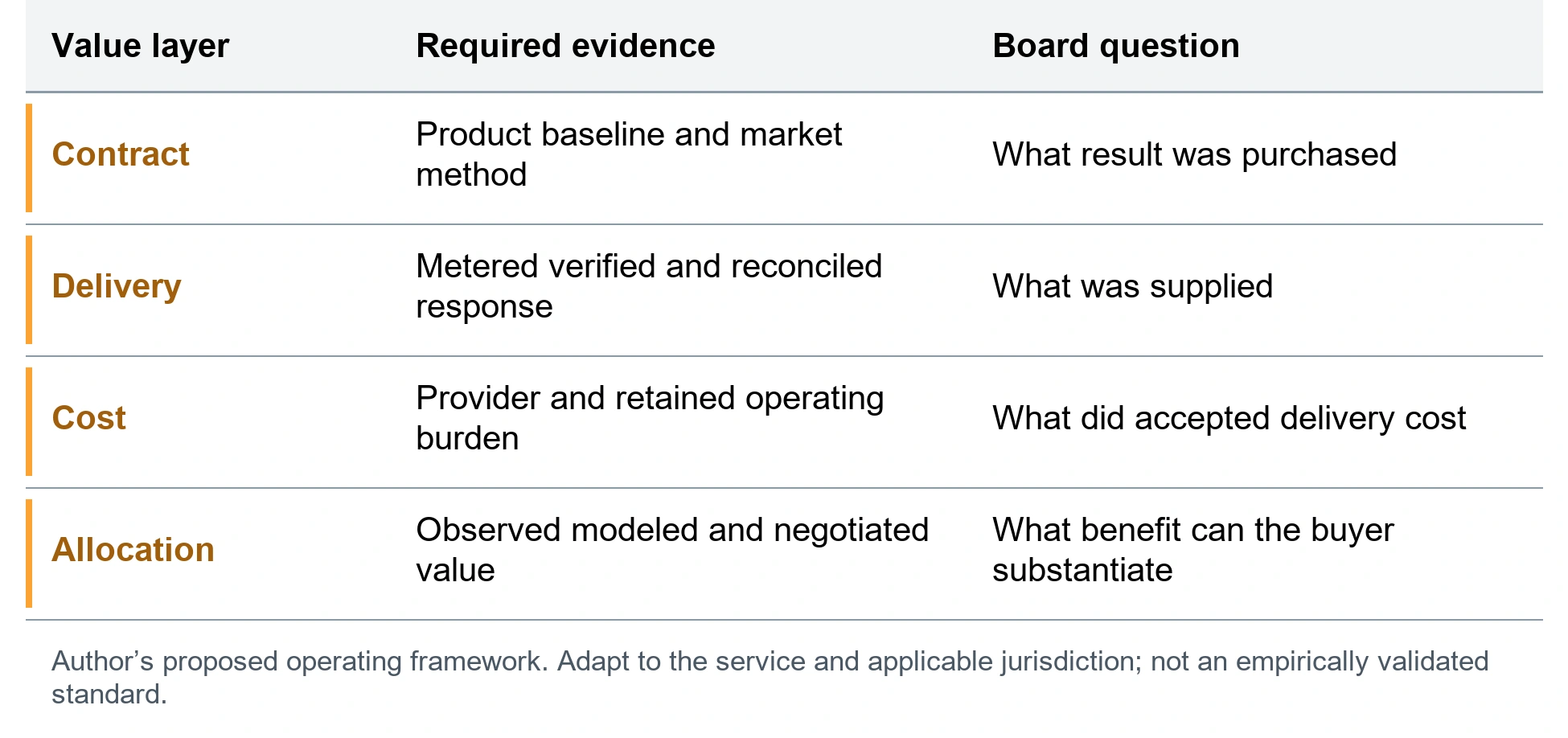
<p>Figure 1 proposes four layers: contracted service, verified delivery, complete cost, and allocated value. Separate market payment from the buyer’s net benefit. Include provider charges, retained operations, data, assurance, exception handling, and any required residual service.</p>
<p><a href="https://www.cyber.gov.au/publication/principles-for-the-secure-integration-of-artificial-intelligence-in-operational-technology">Allied operational-technology guidance emphasizes safety-aware control and fallback.</a><sup id="ref-3"><a href="#note-3" aria-label="Note 3">3</a></sup> It is voluntary guidance, not a market settlement rule. The network should preserve engineering limits and qualified operating authority even where a commercial incentive rewards additional response.</p>
<p>Agree how shared dependencies affect payment and shortfalls. These can include asset availability, communication, network constraints, customer behavior, and external market conditions. Use observable evidence and fair allocation rather than assume every deviation is caused by either the algorithm or the buyer.</p>
<figure><img loading="lazy" src="https://akholi.com/wp-content/uploads/2026/10/108-f1.webp" width="1950" height="918" alt="The flexibility value allocation record. Contract; Product baseline and market method; What result was purchased. Delivery; Metered verified and reconciled response; What was supplied. Cost; Provider and retained operating burden; What did accepted delivery cost. Allocation; Observed modeled and negotiated value; What benefit can the buyer substantiate. Author’s proposed operating framework. Adapt to the service and applicable jurisdiction; not an empirically validated standard."><figcaption>Figure 1. The flexibility value allocation record<small><a href="https://akholi.com/outsourcing-2026-agentic-ai-tier-1-banks/">Phil Hatch, proposed framework developed for this paper.</a></small></figcaption></figure>
<h2 id="section-4">Apply the Actual Market and Engineering Conditions</h2>
<p>EU, UK, Swiss, US, and other electricity markets differ in products, baseline methods, metering, settlement, participation, and network duties. Qualified market, engineering, legal, and finance owners should establish applicable conclusions. A method suitable for one product may be unsuitable for another.</p>
<p>The provider should disclose downstream aggregators, assets, data services, and control dependencies material to the contracted outcome. Test whether the buyer can obtain the evidence needed to challenge delivery or payment. A prime-level summary may conceal a material asset or measurement limitation.</p>
<p>Recovery should preserve a safe operating state and reconcile instructions already issued. Stopping the agent does not necessarily undo a dispatch or restore asset availability. Define qualified authority for restriction and the evidence needed before normal operation resumes.</p>
<h2 id="section-5">Approve Value That Can Be Reconciled</h2>
<p>A reasonable objection is that network value is difficult to attribute precisely. Separate measured delivery, modeled avoided cost, and negotiated allocation. State assumptions and uncertainty rather than present all three as observed savings. A commercial agreement can allocate value without claiming perfect causal proof.</p>
<p>Before scaling, reconcile representative dispatches from instruction through metering, verification, settlement, retained cost, and network effect. Include under-delivery and manual intervention. Resolve discrepancies and retest the affected route before using the result to justify broader authority.</p>
<p>The board should approve a flexibility service whose economic claim survives the physical and market evidence. Agentic optimization can be valuable. The value decision remains grounded in what was contracted, what was verified, what it cost, and what benefit the network retained.</p>
<h2 id="section-6">Evidence and Source Note</h2>
<p>The study is a nonrepresentative cross-section of 850 vendor delivery-team <a href="https://akholi.com/outsourcing-2026-agentic-ai-tier-1-banks/introduction/">respondents</a> on 150 engagements serving Tier 1 financial institutions, collected during January–June 2026. Neither banks nor vendors corroborated the accounts. It establishes reported experience, not causation, legal breach, or market prevalence. Its application here is a mechanism to investigate, not an estimate of conditions in other industries. The author-supplied version 1.8.2 is dated November 1, 2026 and is cited as a forthcoming manuscript consulted October 23, 2026.<sup id="ref-4"><a href="#note-4" aria-label="Note 4">4</a></sup></p>
<p>This is an analytical decision paper based on the supplied study and selected primary public sources checked through October 23, 2026. The original contribution is a grid-flexibility value record separating agent optimization, verified physical delivery, complete cost, and commercial value allocation. The proposed method has not been independently validated. Legal requirements depend on the entity, activity, jurisdiction, and effective provisions; supervisory observations, research, and professional commentary have distinct authority.</p>
<h2 id="notes">Notes</h2><ol class="akp-notes"><li id="note-1">Elexon, Flexibility Market Rules, “Verification and Settlement,” Elexon, Flexibility Market Rules, May 12, 2026, version 2.3; baseline, metering, verification, and settlement provisions, <a href="https://rulebook.elexon.co.uk/flex-market/documents/fmr-vsm-verification-settlement-methodology">https://rulebook.elexon.co.uk/flex-market/documents/fmr-vsm-verification-settlement-methodology</a>. <a href="#ref-1" aria-label="Return to note 1">↩</a></li><li id="note-2">Phil Hatch, <i>Agentic AI Outsourcing at Tier 1 Financial Institutions: Full Study Report</i>, version 1.8.2 (Akholi, forthcoming manuscript dated November 1, 2026), Part 5, “The Five Manual Alteration Methods” and “Disclosure of Manual Alteration,” table 5.8, <a href="https://doi.org/10.2139/ssrn.7164559">https://doi.org/10.2139/ssrn.7164559</a>; Hatch, <i>Agentic AI Outsourcing</i>, Part 3, Third-Party Ecosystem, sec. 6.1, “Mapping of Third and Fourth Party Dependencies,” indicator C196. <a href="#ref-2" aria-label="Return to note 2">↩</a></li><li id="note-3">Cybersecurity and Infrastructure Security Agency and Australian Signals Directorate et al., “Principles for the Secure Integration of Artificial Intelligence in Operational Technology,” Cybersecurity and Infrastructure Security Agency and Australian Signals Directorate et al., December 4, 2025, secs. 2.4 and 4.2, “Embed Safety and Failsafe Mechanisms”, <a href="https://www.cyber.gov.au/publication/principles-for-the-secure-integration-of-artificial-intelligence-in-operational-technology">https://www.cyber.gov.au/publication/principles-for-the-secure-integration-of-artificial-intelligence-in-operational-technology</a>. <a href="#ref-3" aria-label="Return to note 3">↩</a></li><li id="note-4">Hatch, <i>Agentic AI Outsourcing</i>, Introduction, “Executive Summary” and “Evidentiary Basis and Its Limits”. <a href="#ref-4" aria-label="Return to note 4">↩</a></li></ol>
<h2 id="bibliography">Bibliography</h2><ul class="akp-bibliography"><li>Cybersecurity and Infrastructure Security Agency and Australian Signals Directorate et al.. “Principles for the Secure Integration of Artificial Intelligence in Operational Technology.” Cybersecurity and Infrastructure Security Agency and Australian Signals Directorate et al.. December 4, 2025. <a href="https://www.cyber.gov.au/publication/principles-for-the-secure-integration-of-artificial-intelligence-in-operational-technology">https://www.cyber.gov.au/publication/principles-for-the-secure-integration-of-artificial-intelligence-in-operational-technology</a>.</li><li>Elexon, Flexibility Market Rules. “Verification and Settlement.” Elexon, Flexibility Market Rules. May 12, 2026. <a href="https://rulebook.elexon.co.uk/flex-market/documents/fmr-vsm-verification-settlement-methodology">https://rulebook.elexon.co.uk/flex-market/documents/fmr-vsm-verification-settlement-methodology</a>.</li><li>Hatch, Phil. <i>Agentic AI Outsourcing at Tier 1 Financial Institutions: Full Study Report</i>. Version 1.8.2. Akholi. Forthcoming manuscript dated November 1, 2026. Author-supplied manuscript consulted October 23, 2026. <a href="https://doi.org/10.2139/ssrn.7164559">https://doi.org/10.2139/ssrn.7164559</a>.</li></ul>
