# Bank Access Prerequisites Belong in Provider Mobilization

A Provider Method for Ready and Attributable Access

Author: Phil Hatch
Publisher: Akholi
Paper ID: AAO-105
Published: October 23, 2026
Language: en
Canonical: https://akholi.com/papers/bank-access-prerequisites-belong-in-provider-mobilization/
Audience: Financial-services provider transition managers and account directors

Banking service providers should make customer access approvals a tested mobilization dependency. Agent identities, permissions, data routes, environments, and buyer decision owners must be ready before the delivery plan assumes the service can act.

<h2 id="section-1">State the Access the Service Requires</h2>
<p>The provider mobilization leader should identify the actions, systems, data, environments, and administrative roles needed for the offered service. A general request for platform access is too vague for the bank to assess authority and risk. Define the business purpose and minimum required permissions.</p>
<p>NIST’s identity discussion <a href="https://www.nist.gov/blogs/cybersecurity-insights/back-future-why-agentic-ai-needs-strong-identity-foundation">distinguishes agent identities and delegated entitlements from shared credentials.</a><sup id="ref-1"><a href="#note-1" aria-label="Note 1">1</a></sup> The provider should propose an attributable access lifecycle that the bank can approve. A technically convenient borrowed account should not become an undocumented substitute for a delayed design.</p>
<p>For a hypothetical onboarding service, reading documents, retrieving policy, updating a customer record, and granting access are different actions. Each may require a separate permission or approval. The mobilization schedule should reflect those differences rather than assume one credential enables the complete service.</p>
<h2 id="section-2">Expose Buyer Decisions Before They Delay Production</h2>
<p>The <a href="https://akholi.com/outsourcing-2026-agentic-ai-tier-1-banks/part-3-governance-oversight-control/">study</a> reports delayed provisioning and the use of shared or borrowed credentials.<sup id="ref-2"><a href="#note-2" aria-label="Note 2">2</a></sup> It does not establish that every provider lacks attributable access. It identifies a delivery dependency that should be resolved openly rather than concealed by temporary workarounds.</p>
<p>List the bank owner for each access decision, required evidence, approval route, lead time, and test. Include security, data ownership, privacy, business authority, and relevant environment constraints. A named department without a decision owner may not be a usable mobilization dependency.</p>
<p>The provider should disclose what happens if access is not ready. Options can include delayed scope, a restricted pilot, or an approved human route with visible intervention. Do not report unattended agent delivery when people are performing the consequential action under a different access model.</p>
<h2 id="section-3">Use an Access Mobilization Record</h2>
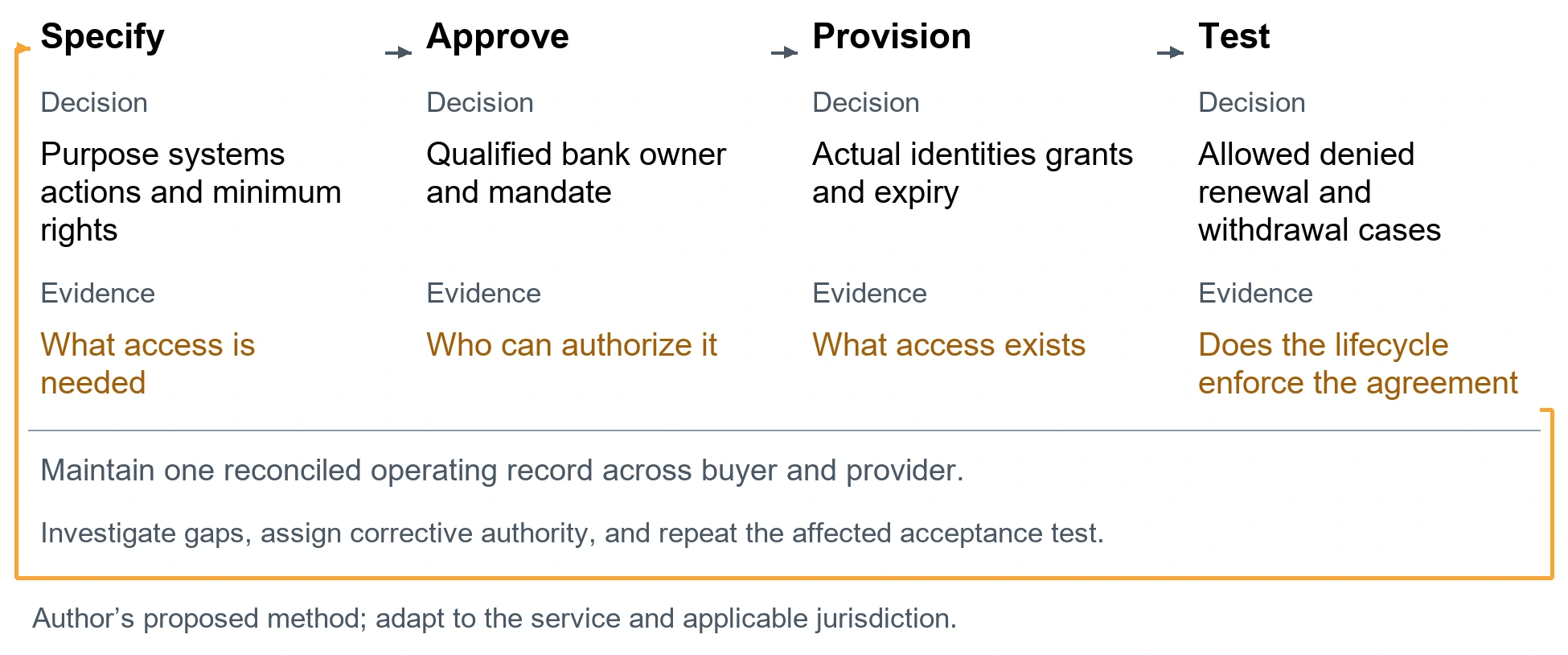
<p>Figure 1 proposes four stages: specify, approve, provision, and test. Connect the business mandate to the actual identity, receiving-system permissions, delegation limits, and expiry. Preserve evidence of both permitted execution and denial outside scope.</p>
<p>Test renewal, revocation, personnel changes, delegated agents, and queued work. A central access record should agree with the identities and permissions present in the systems. Removing a directory entry should not be assumed to terminate all active sessions or downstream authority.</p>
<p><a href="https://www.mayerbrown.com/en/insights/publications/2026/02/contracting-for-agentic-ai-solutions-shifting-the-model-from-saas-to-services">Mayer Brown</a>’s agentic contracting analysis emphasizes defined authority and operating guardrails.<sup id="ref-3"><a href="#note-3" aria-label="Note 3">3</a></sup> The mobilization plan should demonstrate those boundaries before production. Access is part of delivering the accepted service, not merely a technical task detached from the commercial promise.</p>
<figure><img loading="lazy" src="https://akholi.com/wp-content/uploads/2026/10/105-f1.webp" width="1950" height="814" alt="The access mobilization record. Specify. Decision: Purpose systems actions and minimum rights. Evidence: What access is needed. Approve. Decision: Qualified bank owner and mandate. Evidence: Who can authorize it. Provision. Decision: Actual identities grants and expiry. Evidence: What access exists. Test. Decision: Allowed denied renewal and withdrawal cases. Evidence: Does the lifecycle enforce the agreement. Maintain one reconciled operating record across buyer and provider.. Investigate gaps, assign corrective authority, and repeat the affected acceptance test.. Author’s proposed method; adapt to the service and applicable jurisdiction."><figcaption>Figure 1. The access mobilization record<small><a href="https://akholi.com/outsourcing-2026-agentic-ai-tier-1-banks/">Phil Hatch, proposed framework developed for this paper.</a></small></figcaption></figure>
<h2 id="section-4">Align Access with Local Banking Constraints</h2>
<p>EU, UK, Swiss, US, and other banking operations can differ in secrecy, privacy, security, outsourcing, recordkeeping, and reserved authority. The bank should supply approved local requirements and qualified interpretations. The provider should implement and demonstrate the agreed design within its role.</p>
<p>Protect credentials and sensitive configuration while preserving the evidence necessary for attribution and investigation. Separate service identities from administrator identities, and identify who can create or alter either. Unclear administration can undermine a carefully bounded service grant.</p>
<p>Contract milestones and charges should reflect observable buyer prerequisites fairly. A provider should not guarantee a date based on unapproved access assumptions, while a buyer should not accept broad dependency exclusions that remove ordinary delivery responsibility. Agree the consequence of each material delay.</p>
<h2 id="section-5">Release Only the Scope with Tested Access</h2>
<p>A reasonable objection is that detailed access design slows mobilization. Begin early with the bank’s relevant owners and use reusable approved patterns where suitable. The design effort should focus on the consequential action and lifecycle rather than produce unnecessary documentation.</p>
<p>Before production, reconcile the approved mandate, provisioned permissions, test results, unresolved limits, and operating fallback. Have the actual delivery team demonstrate the access route. Restrict unsupported actions and obtain joint acceptance of any temporary method.</p>
<p>The provider should enter production with access that is usable, attributable, bounded, and maintained. A schedule that assumes authority not yet granted is an incomplete delivery plan. Resolving that dependency protects both the bank’s control and the provider’s ability to perform what it has sold.</p>
<h2 id="section-6">Evidence and Source Note</h2>
<p>The study is a nonrepresentative cross-section of 850 vendor delivery-team <a href="https://akholi.com/outsourcing-2026-agentic-ai-tier-1-banks/introduction/">respondents</a> on 150 engagements serving Tier 1 financial institutions, collected during January–June 2026. Neither banks nor vendors corroborated the accounts. It establishes reported experience, not causation, legal breach, or market prevalence. The author-supplied version 1.8.2 is dated November 1, 2026 and is cited as a forthcoming manuscript consulted October 23, 2026.<sup id="ref-4"><a href="#note-4" aria-label="Note 4">4</a></sup></p>
<p>This is an analytical decision paper based on the supplied study and selected primary public sources checked through October 23, 2026. The original contribution is a provider access-mobilization record linking customer prerequisites, attributable identity, tested authority, and production scope. The proposed method has not been independently validated. Legal requirements depend on the entity, activity, jurisdiction, and effective provisions; supervisory observations, research, and professional commentary have distinct authority.</p>
<h2 id="notes">Notes</h2><ol class="akp-notes"><li id="note-1">Bill Fisher and Ryan Galluzzo, “Back to the Future: Why Agentic AI Needs a Strong Identity Foundation,” National Institute of Standards and Technology, August 27, 2026, “Credential Sharing” and “Static and Long-lived Credentials”, <a href="https://www.nist.gov/blogs/cybersecurity-insights/back-future-why-agentic-ai-needs-strong-identity-foundation">https://www.nist.gov/blogs/cybersecurity-insights/back-future-why-agentic-ai-needs-strong-identity-foundation</a>. <a href="#ref-1" aria-label="Return to note 1">↩</a></li><li id="note-2">Phil Hatch, <i>Agentic AI Outsourcing at Tier 1 Financial Institutions: Full Study Report</i>, version 1.8.2 (Akholi, forthcoming manuscript dated November 1, 2026), Part 3, Financial Institution Readiness, sec. 4.1, “Ability to Provision Access and Identities for Agents,” indicator C108, <a href="https://doi.org/10.2139/ssrn.7164559">https://doi.org/10.2139/ssrn.7164559</a>. <a href="#ref-2" aria-label="Return to note 2">↩</a></li><li id="note-3">Rohith P. George et al., “Contracting for Agentic AI Solutions: Shifting the Model from SaaS to Services,” Mayer Brown, February 17, 2026, secs. 1–6, <a href="https://www.mayerbrown.com/en/insights/publications/2026/02/contracting-for-agentic-ai-solutions-shifting-the-model-from-saas-to-services">https://www.mayerbrown.com/en/insights/publications/2026/02/contracting-for-agentic-ai-solutions-shifting-the-model-from-saas-to-services</a>. <a href="#ref-3" aria-label="Return to note 3">↩</a></li><li id="note-4">Hatch, <i>Agentic AI Outsourcing</i>, Introduction, “Executive Summary” and “Evidentiary Basis and Its Limits”. <a href="#ref-4" aria-label="Return to note 4">↩</a></li></ol>
<h2 id="bibliography">Bibliography</h2><ul class="akp-bibliography"><li>Fisher, Bill, and Ryan Galluzzo. “Back to the Future: Why Agentic AI Needs a Strong Identity Foundation.” National Institute of Standards and Technology. August 27, 2026. <a href="https://www.nist.gov/blogs/cybersecurity-insights/back-future-why-agentic-ai-needs-strong-identity-foundation">https://www.nist.gov/blogs/cybersecurity-insights/back-future-why-agentic-ai-needs-strong-identity-foundation</a>.</li><li>George, Rohith P., Joe Pennell, Brad L. Peterson, and Oliver Yaros. “Contracting for Agentic AI Solutions: Shifting the Model from SaaS to Services.” Mayer Brown. February 17, 2026. <a href="https://www.mayerbrown.com/en/insights/publications/2026/02/contracting-for-agentic-ai-solutions-shifting-the-model-from-saas-to-services">https://www.mayerbrown.com/en/insights/publications/2026/02/contracting-for-agentic-ai-solutions-shifting-the-model-from-saas-to-services</a>.</li><li>Hatch, Phil. <i>Agentic AI Outsourcing at Tier 1 Financial Institutions: Full Study Report</i>. Version 1.8.2. Akholi. Forthcoming manuscript dated November 1, 2026. Author-supplied manuscript consulted October 23, 2026. <a href="https://doi.org/10.2139/ssrn.7164559">https://doi.org/10.2139/ssrn.7164559</a>.</li></ul>
