# Reviewing Incumbent Renewals as Agentic Delivery Changes

A Sourcing Management Method for a Changed Service

Author: Phil Hatch
Publisher: Akholi
Paper ID: AAO-099
Published: October 23, 2026
Language: en
Canonical: https://akholi.com/papers/reviewing-incumbent-renewals-as-agentic-delivery-changes/
Audience: Incumbent relationship owners and procurement category managers

Sourcing managers should treat an incumbent renewal as a reassessment of the service now being delivered. Agentic changes can alter authority, human work, cost, evidence, dependencies, and exit capability even when the supplier and contract title remain the same.

<h2 id="section-1">Compare the Contracted Service with the Live Method</h2>
<p>The sourcing manager should establish what changed since the last agreement: tasks, models, tools, data, staffing, subcontractors, permissions, and customer effects. A renewal based only on the old rate card can preserve terms designed for a different delivery model.</p>
<p><a href="https://www.morganlewis.com/pubs/2026/07/ai-enabled-outsourcing-key-contract-pricing-and-governance-considerations">Morgan Lewis</a>’s outsourcing overview emphasizes revisiting governance, pricing, data, and IP as AI becomes an operating layer.<sup id="ref-1"><a href="#note-1" aria-label="Note 1">1</a></sup> It is practitioner guidance, not evidence that every incumbent contract is unsuitable. The manager should identify the material differences in the actual service.</p>
<p>Ask the business owner and provider to reconcile the current workflow to the approved scope. Include activities introduced informally or through platform updates. A supplier’s continuity of brand does not establish continuity of operating risk or commercial value.</p>
<h2 id="section-2">Rebuild the Functional Comparison</h2>
<p>The <a href="https://akholi.com/outsourcing-2026-agentic-ai-tier-1-banks/part-5-manual-alteration/">study</a> reports <a href="https://akholi.com/outsourcing-2026-agentic-ai-tier-1-banks/part-2-five-failure-categories/">manual intervention and processes not adapted to agentic delivery.</a><sup id="ref-2"><a href="#note-2" aria-label="Note 2">2</a></sup> It does not establish the renewal price a buyer should accept. It identifies why staffing reductions and automation percentages may omit the work needed to complete the function.</p>
<p>Compare current accepted outcomes, quality, elapsed time, total cost, retained buyer effort, and material exceptions with a stated baseline. Separate observed benefits from forecasts. If the original baseline is missing, reconstruct it from available records and disclose the method and uncertainty.</p>
<p>For a hypothetical renewal, the provider may offer lower handling rates while the buyer has added reviewers and exception staff. The manager should assess the complete functional cost before describing the offer as savings. A narrower provider boundary can make a lower rate commercially misleading.</p>
<h2 id="section-3">Use a Renewal Change Record</h2>
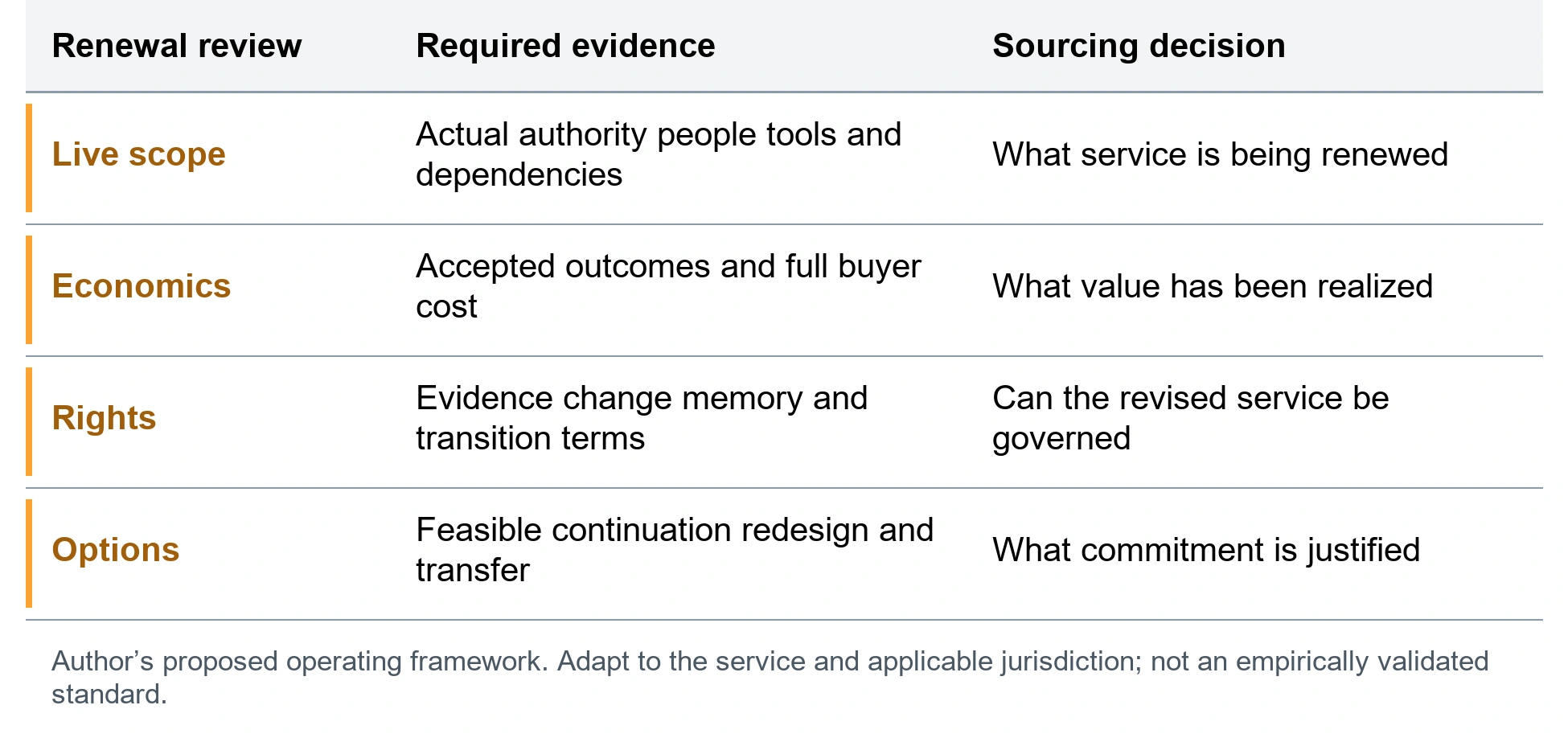
<p>Figure 1 proposes four reviews: live scope, economic evidence, operating rights, and future options. Identify the contract changes needed for authority, intervention reporting, evidence, material updates, downstream cooperation, and acceptance. Resolve contradictions before extending dependency.</p>
<p>BCG’s services <a href="https://www.bcg.com/publications/2026/the-200-billion-dollar-ai-opportunity-in-tech-services">research describes unsettled commercial models and differing value expectations.</a><sup id="ref-3"><a href="#note-3" aria-label="Note 3">3</a></sup> The renewal should therefore establish what the buyer will pay for and how the result is verified. Do not adopt outcome pricing merely because it is a market trend.</p>
<p>Review memory, workflow IP, data use, training permissions, and transition assets. Determine what the buyer can retain, inspect, and provide to a successor. An incumbent’s accumulated context can be valuable while increasing the practical cost of switching.</p>
<figure><img loading="lazy" src="https://akholi.com/wp-content/uploads/2026/10/099-f1.webp" width="1950" height="918" alt="The renewal change record. Live scope; Actual authority people tools and dependencies; What service is being renewed. Economics; Accepted outcomes and full buyer cost; What value has been realized. Rights; Evidence change memory and transition terms; Can the revised service be governed. Options; Feasible continuation redesign and transfer; What commitment is justified. Author’s proposed operating framework. Adapt to the service and applicable jurisdiction; not an empirically validated standard."><figcaption>Figure 1. The renewal change record<small><a href="https://akholi.com/outsourcing-2026-agentic-ai-tier-1-banks/">Phil Hatch, proposed framework developed for this paper.</a></small></figcaption></figure>
<h2 id="section-4">Test Options Before the Renewal Deadline</h2>
<p>Begin early enough to evaluate continuation, redesign, partial transfer, competitive sourcing, and restricted scope. A credible alternative requires rights, access, knowledge, and operating evidence. A theoretical right to terminate is weak negotiating support if no one can continue the function.</p>
<p>EU, UK, Swiss, US, and other legal, sector, privacy, labor, and records conditions may have changed or apply differently to the revised service. Qualified owners should establish current conclusions. Avoid treating an old approval as permanent coverage for new agent authority.</p>
<p>Align renewal milestones with buyer readiness and production acceptance. If a material improvement remains unproven, use a bounded commitment with a clear evidence and continuation test. Preserve the ability to revise scope without misrepresenting a future capability as current delivery.</p>
<h2 id="section-5">Renew the Service the Evidence Supports</h2>
<p>A reasonable objection is that reopening many terms can destabilize a functioning relationship. Prioritize changes that affect material outcomes, authority, cost, and continuity. Reuse provisions that remain fit for purpose and resolve specific gaps with the incumbent before broad replacement is considered.</p>
<p>Bring the decision owner a concise comparison of options, complete economics, unresolved limitations, and implementation requirements. State the consequence of doing nothing. A renewal should be an affirmative decision about the future service, not an administrative response to an approaching expiry.</p>
<p>The manager should renew when the current delivery method, price, rights, and governance support the buyer’s needs. Incumbency can provide knowledge and continuity. It should not prevent scrutiny of a service that has changed substantially beneath an unchanged contract title.</p>
<h2 id="section-6">Evidence and Source Note</h2>
<p>The study is a nonrepresentative cross-section of 850 vendor delivery-team <a href="https://akholi.com/outsourcing-2026-agentic-ai-tier-1-banks/introduction/">respondents</a> on 150 engagements serving Tier 1 financial institutions, collected during January–June 2026. Neither banks nor vendors corroborated the accounts. It establishes reported experience, not causation, legal breach, or market prevalence. Its application here is a mechanism to investigate, not an estimate of conditions in other industries. The author-supplied version 1.8.2 is dated November 1, 2026 and is cited as a forthcoming manuscript consulted October 23, 2026.<sup id="ref-4"><a href="#note-4" aria-label="Note 4">4</a></sup></p>
<p>This is an analytical decision paper based on the supplied study and selected primary public sources checked through October 23, 2026. The original contribution is a renewal-change record connecting live agentic delivery differences to full economics, updated rights, and feasible sourcing options. The proposed method has not been independently validated. Legal requirements depend on the entity, activity, jurisdiction, and effective provisions; supervisory observations, research, and professional commentary have distinct authority.</p>
<h2 id="notes">Notes</h2><ol class="akp-notes"><li id="note-1">Barbara Murphy Melby et al., “AI-Enabled Outsourcing: Key Contract, Pricing, and Governance Considerations,” Morgan Lewis, July 2026, public report overview and key takeaways, <a href="https://www.morganlewis.com/pubs/2026/07/ai-enabled-outsourcing-key-contract-pricing-and-governance-considerations">https://www.morganlewis.com/pubs/2026/07/ai-enabled-outsourcing-key-contract-pricing-and-governance-considerations</a>. <a href="#ref-1" aria-label="Return to note 1">↩</a></li><li id="note-2">Phil Hatch, <i>Agentic AI Outsourcing at Tier 1 Financial Institutions: Full Study Report</i>, version 1.8.2 (Akholi, forthcoming manuscript dated November 1, 2026), Part 5, “The Five Manual Alteration Methods” and “Disclosure of Manual Alteration,” table 5.8, <a href="https://doi.org/10.2139/ssrn.7164559">https://doi.org/10.2139/ssrn.7164559</a>; Hatch, <i>Agentic AI Outsourcing</i>, Part 2, “The Shift From Managing People to Managing Agents”; Part 6, “The Executive Action Plan”. <a href="#ref-2" aria-label="Return to note 2">↩</a></li><li id="note-3">Vikash Jain et al., “The $200 Billion Agentic AI Opportunity for Tech Service Providers,” Boston Consulting Group, February 20, 2026, demand and supply survey methodology; expectation and commitment gaps, <a href="https://www.bcg.com/publications/2026/the-200-billion-dollar-ai-opportunity-in-tech-services">https://www.bcg.com/publications/2026/the-200-billion-dollar-ai-opportunity-in-tech-services</a>. <a href="#ref-3" aria-label="Return to note 3">↩</a></li><li id="note-4">Hatch, <i>Agentic AI Outsourcing</i>, Introduction, “Executive Summary” and “Evidentiary Basis and Its Limits”. <a href="#ref-4" aria-label="Return to note 4">↩</a></li></ol>
<h2 id="bibliography">Bibliography</h2><ul class="akp-bibliography"><li>Hatch, Phil. <i>Agentic AI Outsourcing at Tier 1 Financial Institutions: Full Study Report</i>. Version 1.8.2. Akholi. Forthcoming manuscript dated November 1, 2026. Author-supplied manuscript consulted October 23, 2026. <a href="https://doi.org/10.2139/ssrn.7164559">https://doi.org/10.2139/ssrn.7164559</a>.</li><li>Jain, Vikash, Sudhanshu Chawla, Saurav Mohanty, Hiren Mittal, Anoop Gopal Singh, Sahib Katyal, and Shailee Raychaudhuri. “The $200 Billion Agentic AI Opportunity for Tech Service Providers.” Boston Consulting Group. February 20, 2026. <a href="https://www.bcg.com/publications/2026/the-200-billion-dollar-ai-opportunity-in-tech-services">https://www.bcg.com/publications/2026/the-200-billion-dollar-ai-opportunity-in-tech-services</a>.</li><li>Melby, Barbara Murphy, Marina G. Aronchik, and C. Kari Krusmark. “AI-Enabled Outsourcing: Key Contract, Pricing, and Governance Considerations.” Morgan Lewis. July 2026. <a href="https://www.morganlewis.com/pubs/2026/07/ai-enabled-outsourcing-key-contract-pricing-and-governance-considerations">https://www.morganlewis.com/pubs/2026/07/ai-enabled-outsourcing-key-contract-pricing-and-governance-considerations</a>.</li></ul>
