# Medical AI Outsourcing Needs a Post-Market Evidence Handoff

A Management Method for Ongoing Device Assurance

Author: Phil Hatch
Publisher: Akholi
Paper ID: AAO-094
Published: October 23, 2026
Language: en
Canonical: https://akholi.com/papers/medical-ai-outsourcing-needs-a-post-market-evidence-handoff/
Audience: Medical-device supplier manager, post-market surveillance lead, healthcare technology vendor manager

Medical AI service managers should define how operational signals reach the party responsible for assessing safety and performance after deployment. A supplier’s uptime report does not replace a joined evidence route for complaints, changed behavior, human correction, and relevant incidents.

<h2 id="section-1">Connect Live Use to the Responsible Evidence Owner</h2>
<p>The manager should identify who receives, assesses, and acts on information about the deployed service’s safety and performance. Manufacturers, providers, deploying organizations, clinicians, and users can hold different parts of the evidence. Their actual roles and applicable duties should determine the handoff.</p>
<p>MHRA’s <a href="https://www.gov.uk/government/publications/software-and-artificial-intelligence-ai-as-a-medical-device">software-and-AI programme identifies post-market monitoring as a lifecycle concern.</a><sup id="ref-1"><a href="#note-1" aria-label="Note 1">1</a></sup> The linked guidance and applicable current rules require activity-specific review. The manager should not treat a programme statement or sandbox as product authorization or a complete statement of every party’s duty.</p>
<p>Define the deployed function, configuration, user population, clinical context, and expected performance. Without that context, a signal may be impossible to interpret. A provider should not aggregate away the version or use conditions needed to identify an affected population.</p>
<h2 id="section-2">Capture the Signals the Service Contract Can Miss</h2>
<p>Relevant evidence can include unexpected outputs, changed workflow, manual correction, user confusion, failed escalation, complaints, and consequential tool actions. Technical availability measures only one aspect. A service can be online while delivering an unsuitable result or imposing unexpected work on clinicians.</p>
<p>The <a href="https://akholi.com/outsourcing-2026-agentic-ai-tier-1-banks/part-5-manual-alteration/">study</a> <a href="https://akholi.com/outsourcing-2026-agentic-ai-tier-1-banks/part-2-five-failure-categories/">reports manual intervention and limited visibility across firms.</a><sup id="ref-2"><a href="#note-2" aria-label="Note 2">2</a></sup> Those banking observations do not establish medical-device harm. They identify why the manager should test whether corrective human work and failures are visible to the responsible clinical and quality owners.</p>
<p>For a hypothetical support service, clinicians may repeatedly correct a category of output without reporting each instance as an incident. The manager should establish a proportionate route to detect the pattern and assess its significance. Avoid assuming that low formal incident counts establish good performance.</p>
<h2 id="section-3">Use a Post Market Evidence Handoff Record</h2>
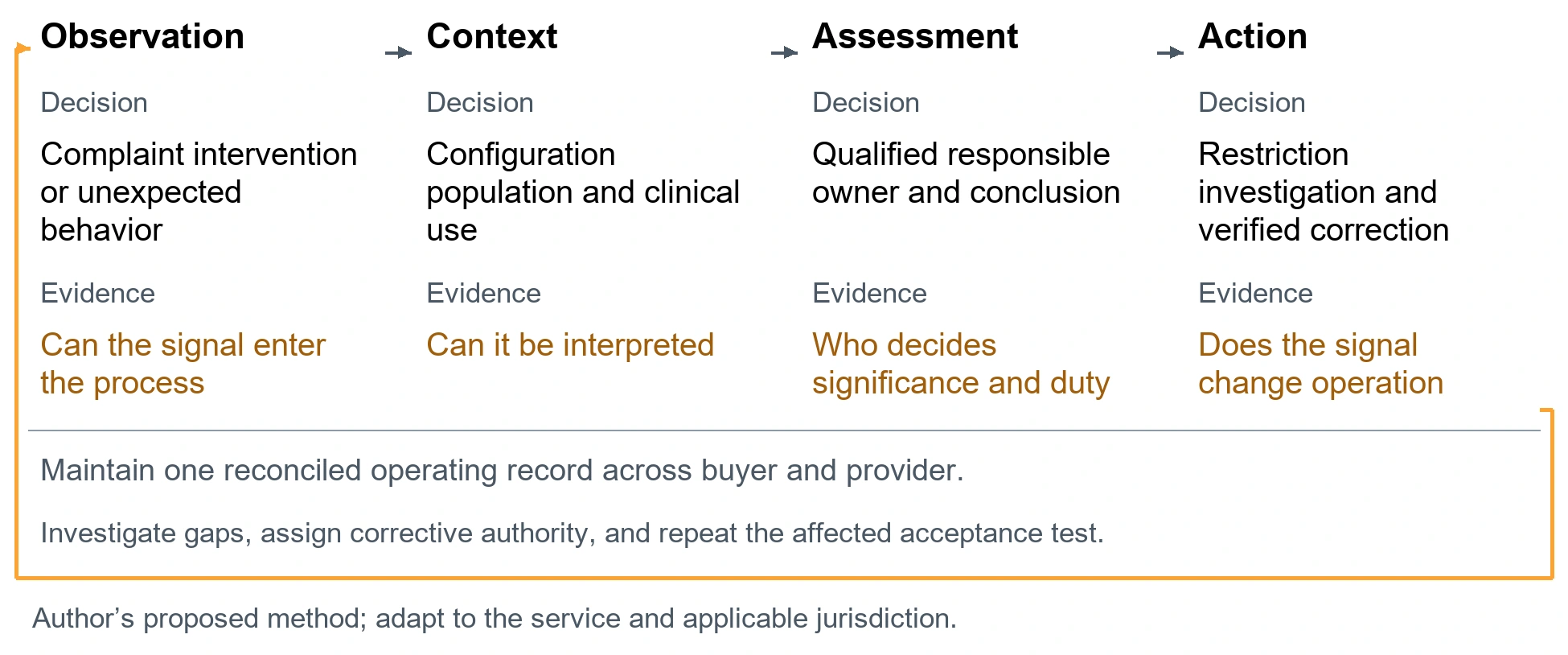
<p>Figure 1 proposes four links: observation, context, qualified assessment, and action. Record who supplies each item, required timing, secure access, and escalation when information is incomplete. Preserve the original signal and subsequent corrections.</p>
<p>FDA’s PCCP <a href="https://www.fda.gov/medical-devices/premarket-submissions-selecting-and-preparing-correct-submission/predetermined-change-control-plans">explanation includes assessment of individual and cumulative modification effects.</a><sup id="ref-3"><a href="#note-3" aria-label="Note 3">3</a></sup> It applies within the relevant US device context. The broader operating lesson is to connect supplier changes and observed performance to the qualified lifecycle decision rather than keep separate technical and clinical reporting streams.</p>
<p>Test whether the responsible team can identify affected configurations, users, and cases, obtain supporting records, and direct a restriction or investigation. The service should distinguish signal collection from the formal determination of reportability or corrective action, which belongs to the appropriately responsible qualified parties.</p>
<figure><img loading="lazy" src="https://akholi.com/wp-content/uploads/2026/10/094-f1.webp" width="1950" height="814" alt="The post market evidence handoff record. Observation. Decision: Complaint intervention or unexpected behavior. Evidence: Can the signal enter the process. Context. Decision: Configuration population and clinical use. Evidence: Can it be interpreted. Assessment. Decision: Qualified responsible owner and conclusion. Evidence: Who decides significance and duty. Action. Decision: Restriction investigation and verified correction. Evidence: Does the signal change operation. Maintain one reconciled operating record across buyer and provider.. Investigate gaps, assign corrective authority, and repeat the affected acceptance test.. Author’s proposed method; adapt to the service and applicable jurisdiction."><figcaption>Figure 1. The post market evidence handoff record<small><a href="https://akholi.com/outsourcing-2026-agentic-ai-tier-1-banks/">Phil Hatch, proposed framework developed for this paper.</a></small></figcaption></figure>
<h2 id="section-4">Apply Local Duties and Protect Information</h2>
<p>EU, UK, Swiss, US, and other device and healthcare regimes differ in surveillance, vigilance, privacy, records, and responsible roles. Specialists should determine applicable requirements and deadlines. Contractual incident notice should support those decisions rather than be mistaken for the statutory notification itself.</p>
<p>Minimize and protect sensitive patient information while retaining enough context to assess the signal. Agree authorized recipients and downstream cooperation. A supplier confidentiality restriction should be resolved before it prevents a necessary investigation, with lawful controlled access where appropriate.</p>
<p>Include model, tool, data, and workflow changes in the evidence route. A performance issue may arise from the operating environment rather than a model update. Preserve enough configuration and context to evaluate both possibilities without assuming causation from timing alone.</p>
<h2 id="section-5">Verify That Signals Produce Decisions</h2>
<p>A reasonable objection is that broad collection will overwhelm the quality team. Define proportionate categories, triage, aggregation, and escalation. The objective is useful evidence and timely qualified assessment, not indiscriminate reporting that buries consequential signals.</p>
<p>Before acceptance, run a controlled signal from user observation through provider records to qualified assessment and action. Include missing information, a downstream dependency, and a changed configuration. Time the handoff and resolve gaps in authority, evidence, or access.</p>
<p>The manager should accept the post-market model when relevant live evidence reaches a party able and obliged to act on it. Collecting signals is only the first step. Ongoing assurance requires a maintained connection from observation to assessment, decision, correction, and verification.</p>
<h2 id="section-6">Evidence and Source Note</h2>
<p>The study is a nonrepresentative cross-section of 850 vendor delivery-team <a href="https://akholi.com/outsourcing-2026-agentic-ai-tier-1-banks/introduction/">respondents</a> on 150 engagements serving Tier 1 financial institutions, collected during January–June 2026. Neither banks nor vendors corroborated the accounts. It establishes reported experience, not causation, legal breach, or market prevalence. Its application here is a mechanism to investigate, not an estimate of conditions in other industries. The author-supplied version 1.8.2 is dated November 1, 2026 and is cited as a forthcoming manuscript consulted October 23, 2026.<sup id="ref-4"><a href="#note-4" aria-label="Note 4">4</a></sup></p>
<p>This is an analytical decision paper based on the supplied study and selected primary public sources checked through October 23, 2026. The original contribution is a post-market handoff record connecting provider operating evidence to qualified device and clinical lifecycle decisions. The proposed method has not been independently validated. Legal requirements depend on the entity, activity, jurisdiction, and effective provisions; supervisory observations, research, and professional commentary have distinct authority.</p>
<h2 id="notes">Notes</h2><ol class="akp-notes"><li id="note-1">Medicines and Healthcare products Regulatory Agency, “Medical Devices: Software and Artificial Intelligence (AI),” Medicines and Healthcare products Regulatory Agency, updated February 3, 2025, scope of software meeting a clinical need and linked guidance, <a href="https://www.gov.uk/government/publications/software-and-artificial-intelligence-ai-as-a-medical-device">https://www.gov.uk/government/publications/software-and-artificial-intelligence-ai-as-a-medical-device</a>. <a href="#ref-1" aria-label="Return to note 1">↩</a></li><li id="note-2">Phil Hatch, <i>Agentic AI Outsourcing at Tier 1 Financial Institutions: Full Study Report</i>, version 1.8.2 (Akholi, forthcoming manuscript dated November 1, 2026), Part 5, “The Five Manual Alteration Methods” and “Disclosure of Manual Alteration,” table 5.8, <a href="https://doi.org/10.2139/ssrn.7164559">https://doi.org/10.2139/ssrn.7164559</a>; Hatch, <i>Agentic AI Outsourcing</i>, Part 2, sec. 5.1, “Agent Actions Visible Only Inside Each Firm’s Own Tools”. <a href="#ref-2" aria-label="Return to note 2">↩</a></li><li id="note-3">US Food and Drug Administration, “Predetermined Change Control Plans,” US Food and Drug Administration, accessed October 23, 2026, PCCP scope, authorized modifications, and impact assessment, <a href="https://www.fda.gov/medical-devices/premarket-submissions-selecting-and-preparing-correct-submission/predetermined-change-control-plans">https://www.fda.gov/medical-devices/premarket-submissions-selecting-and-preparing-correct-submission/predetermined-change-control-plans</a>. <a href="#ref-3" aria-label="Return to note 3">↩</a></li><li id="note-4">Hatch, <i>Agentic AI Outsourcing</i>, Introduction, “Executive Summary” and “Evidentiary Basis and Its Limits”. <a href="#ref-4" aria-label="Return to note 4">↩</a></li></ol>
<h2 id="bibliography">Bibliography</h2><ul class="akp-bibliography"><li>Hatch, Phil. <i>Agentic AI Outsourcing at Tier 1 Financial Institutions: Full Study Report</i>. Version 1.8.2. Akholi. Forthcoming manuscript dated November 1, 2026. Author-supplied manuscript consulted October 23, 2026. <a href="https://doi.org/10.2139/ssrn.7164559">https://doi.org/10.2139/ssrn.7164559</a>.</li><li>Medicines and Healthcare products Regulatory Agency. “Medical Devices: Software and Artificial Intelligence (AI).” Medicines and Healthcare products Regulatory Agency. Updated February 3, 2025. <a href="https://www.gov.uk/government/publications/software-and-artificial-intelligence-ai-as-a-medical-device">https://www.gov.uk/government/publications/software-and-artificial-intelligence-ai-as-a-medical-device</a>.</li><li>US Food and Drug Administration. “Predetermined Change Control Plans.” US Food and Drug Administration. Accessed October 23, 2026. <a href="https://www.fda.gov/medical-devices/premarket-submissions-selecting-and-preparing-correct-submission/predetermined-change-control-plans">https://www.fda.gov/medical-devices/premarket-submissions-selecting-and-preparing-correct-submission/predetermined-change-control-plans</a>.</li></ul>
