The executive should ask where the service waits for a consequential decision and what that delay does to the business result. Waiting can occur for access, policy interpretation, exception approval, customer action, or incident authority. A model’s response time does not capture these operating delays.
McKinsey’s October 2026 organizational analysis emphasizes clearer decision rights and fewer unnecessary handoffs.1 It is a proposed organizational approach supported by research and practice, not a causal estimate for this deal. The executive should test the decision constraints in the actual two-firm workflow.
Begin with a critical outcome and trace the elapsed time from request to accepted result. Separate useful processing, necessary review, missing information, unavailable authority, and avoidable coordination. A decision made quickly on inadequate evidence should not be counted as an improvement.
The study reports joint decisions that did not keep pace with agentic delivery.2 It does not establish that all delay is waste. Some waiting protects required review or customer choice. The executive should distinguish necessary judgment from organizational friction that neither firm has authority to resolve.
For a hypothetical service, a provider can identify an exception immediately while the buyer’s authorized decision body meets weekly. The resulting backlog is an operating-model constraint. The choice is to delegate bounded decisions, provide timely specialist coverage, narrow service scope, or accept the delay explicitly.
The provider should supply a decision-ready case: facts, uncertainty, attempted actions, available options, consequence, and deadline. The buyer should supply qualified authority and an escalation route. Faster messages between unprepared teams do not close the gap.
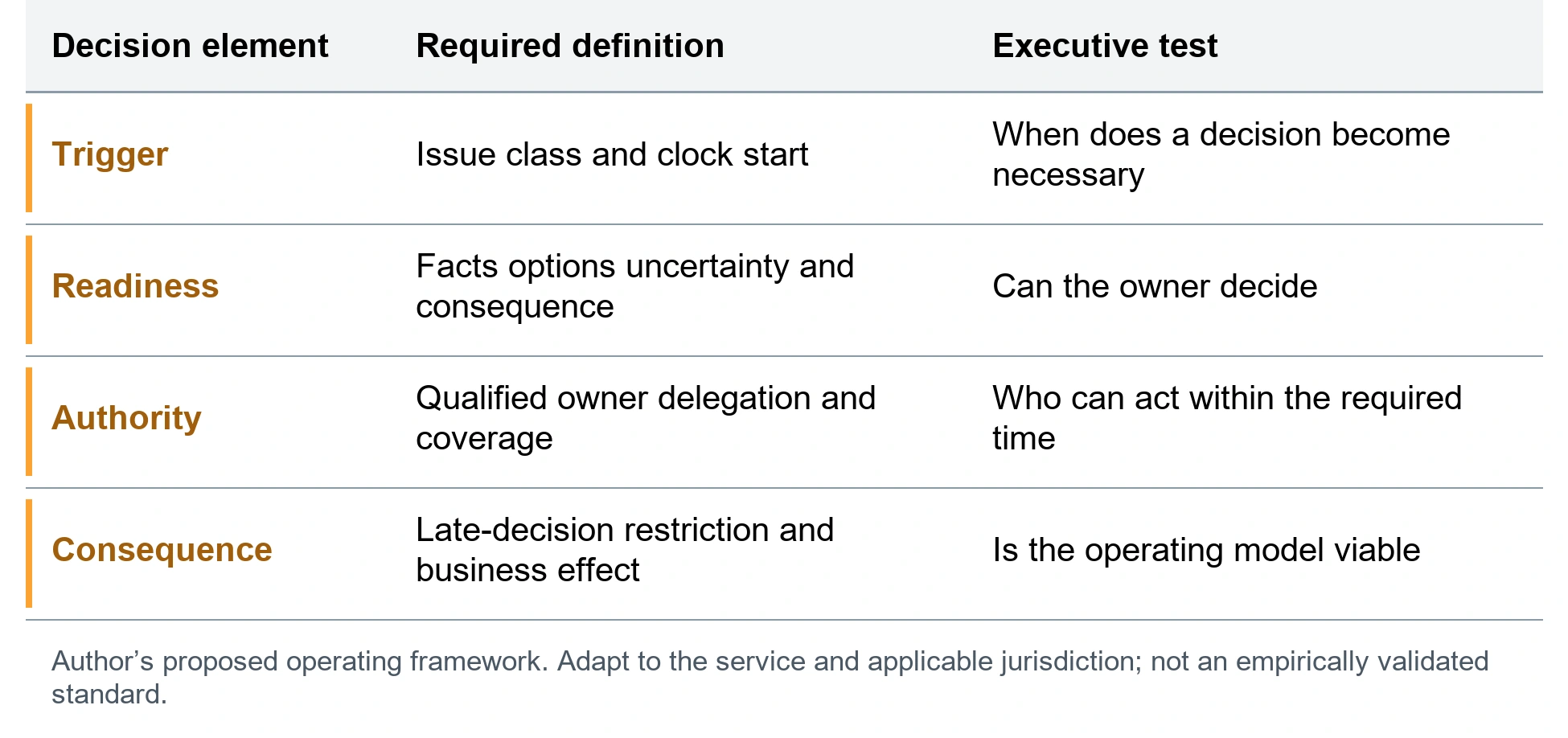
Figure 1 proposes four elements: trigger, evidence readiness, authorized response, and consequence. Set a decision-time expectation appropriate to each class of issue. Record when the clock starts, what pauses it, and what restricted operation applies if the decision is late.
Measure actual cases and distinguish average time from consequential outliers and aging backlog. A small number of delayed approvals may dominate the business effect. Do not impose one universal response target on routine questions, financial authority, clinical judgment, and emergency containment.
PwC’s agentic shared-services discussion emphasizes operating-model redesign around outcomes.3 The two-party extension is to design authority across the contractual boundary. The commercial agreement should recognize the decisions both firms must provide and the evidence needed to make them.
Fund the people, access, tools, and delegation required for the intended decision speed. A response target without qualified coverage can become nominal. Include peak demand, absences, time zones, and simultaneous incidents when testing the operating model.
EU, UK, Swiss, US, and other requirements may reserve particular decisions or require specific qualifications and evidence. Establish those constraints before delegating. Removing a necessary review to improve cycle time can create a different risk rather than a better service.
Commercial terms should allocate buyer and provider dependencies fairly without making delay attribution a substitute for resolution. Preserve a route for urgent operating action while the firms separately determine cost and responsibility. The business consequence should remain visible even when neither party accepts blame.
A reasonable objection is that faster decisions require more expensive retained capacity. Compare that cost with delayed outcomes, rework, idle provider capacity, and lost value. The executive may choose a slower or narrower service if the complete economics are better. The assumption should be explicit.
Before scaling, test representative decisions with the live roles and evidence. Measure time to a usable decision and verify that the resulting action is correct and authorized. Resolve recurring information gaps and unowned handoffs before treating the service as ready for higher volume.
The executive should approve machine speed and human decision capacity as one operating design. Agentic delivery improves the function when both firms can make the necessary decisions at the required time. Otherwise, the service accelerates work into a queue the organization has not equipped itself to govern.
The study is a nonrepresentative cross-section of 850 vendor delivery-team respondents on 150 engagements serving Tier 1 financial institutions, collected during January–June 2026. Neither banks nor vendors corroborated the accounts. It establishes reported experience, not causation, legal breach, or market prevalence. Its application here is a mechanism to investigate, not an estimate of conditions in other industries. The author-supplied version 1.8.2 is dated November 1, 2026 and is cited as a forthcoming manuscript consulted October 23, 2026.4
This is an analytical decision paper based on the supplied study and selected primary public sources checked through October 23, 2026. The original contribution is a joint decision-time record connecting evidence readiness, cross-firm authority, capacity, and the consequence of delayed decisions. The proposed method has not been independently validated. Legal requirements depend on the entity, activity, jurisdiction, and effective provisions; supervisory observations, research, and professional commentary have distinct authority.