The provider’s commercial leader should define the function, period, workload, quality, and benefit the bid promises. Distinguish lower price, reduced buyer effort, faster completion, improved quality, and new capability. These can create value through different mechanisms and should not be combined into an unexplained savings percentage.
KPMG’s US survey reports value across productivity, decision speed, experience, and financial performance.1 It is self-reported research, not proof of a provider’s proposed result. It illustrates why a credible bid should name the specific value mechanism and evidence rather than promise generic AI return.
Choose a unit the buyer can reconcile to its business function. State whether the claim concerns attempted transactions, accepted outcomes, or sustained results after correction. Define the eligible population and exclusions before the pilot so that scope does not shift when performance is measured.
The study identifies manual work and process limitations that can be omitted from a delivery claim.2 It does not quantify supplier overstatement. A provider can address the concern directly by disclosing the human effort, customer work, and dependencies underlying its results.
For a hypothetical pilot, the provider may demonstrate faster handling on a selected case set. Report the selection, operating conditions, staff support, and limitations. A forecast for the full population should identify the assumptions required to transfer that result to different volumes and case complexity.
Do not present released staff hours as cash savings unless the buyer can capture them in that form. They may support capacity, quality, or growth instead. State the capture mechanism and who must act. A valid efficiency observation can still support an overstated financial claim if the benefit category is wrong.
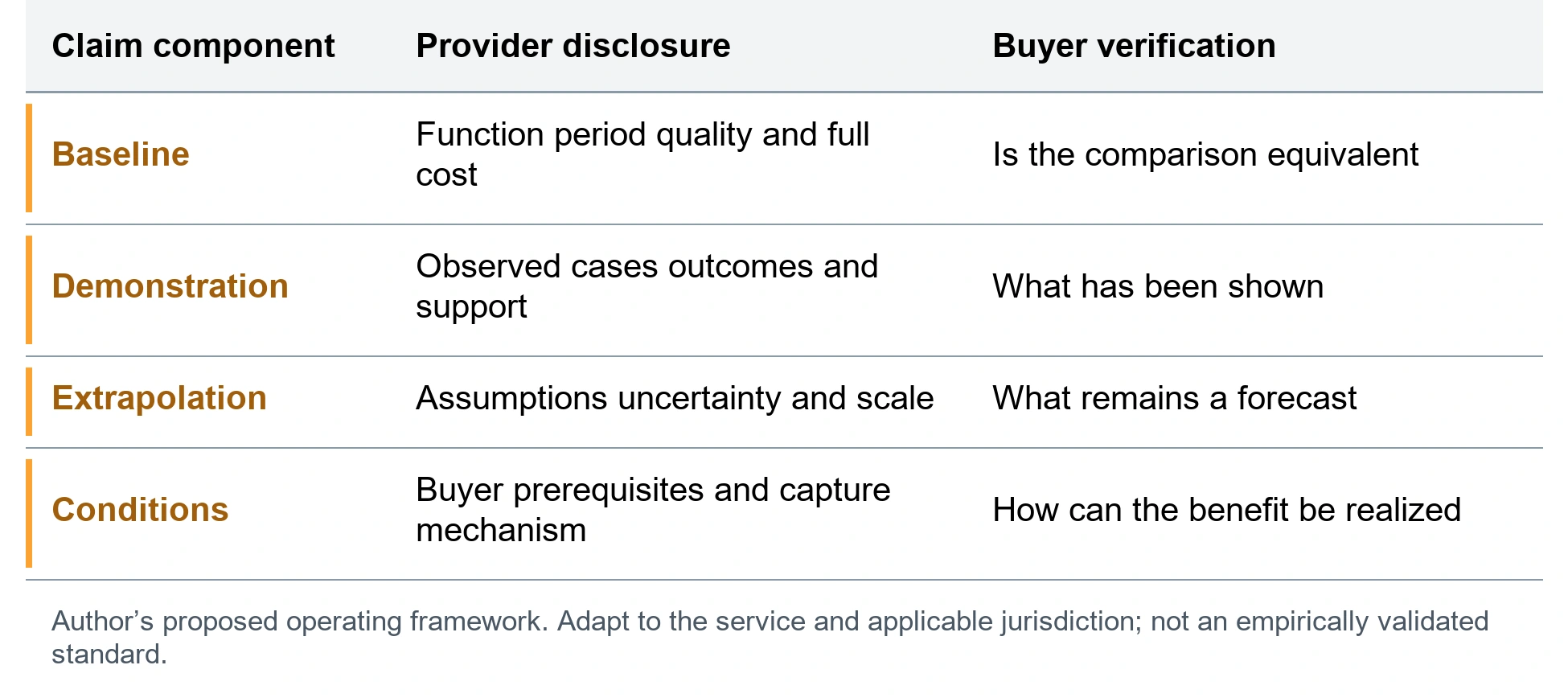
Figure 1 proposes four sections: baseline, demonstration, extrapolation, and buyer conditions. Include source records, calculation rules, cost inclusions, uncertainty, and the continuation test. Keep the sheet concise enough for commercial review while linking to evidence available for authorized challenge.
Show transition, technology consumption, review, corrections, assurance, and necessary recovery costs. Where a cost is excluded because the buyer retains it, say so. Protect proprietary provider economics while making the customer’s total functional comparison testable.
Bain’s service-provider analysis emphasizes new commercial models and measurable outcomes.3 The proposed evidence sheet is a practical response to that market direction. It helps distinguish a price concession, a delivery improvement, and an expected future benefit before they become contract commitments.
Identify access, data quality, decision timing, scope standardization, and retained expertise needed from the buyer. Define how missing prerequisites affect delivery and price. A broad customer-dependency exclusion should not make the value claim impossible to disprove.
EU, UK, Swiss, US, and other local obligations may change the feasible workflow and cost. State the relevant operating assumptions and obtain qualified review where needed. A global price should not rely on an unverified assumption that all work can move to one location or use one control model.
Agree evidence access, review dates, adjustment rules, and treatment of changed scope. Preserve the original baseline alongside later revisions. This allows both firms to understand whether a change improved the service or merely changed the comparison.
A reasonable objection is that explicit uncertainty weakens the bid. It can strengthen credibility when paired with a bounded demonstration and clear plan to resolve important assumptions. Buyers can fund learning without being asked to treat a forecast as an observed result.
Before submission, ask an internal reviewer independent of the sales calculation to reconstruct the claim from the evidence sheet. Resolve unsupported comparisons, omitted work, double-counted benefits, and unclear dependencies. Prepare the explanation a buyer CFO or sourcing team will need.
The provider should offer a value claim that remains coherent under scrutiny. Commercial confidence comes from a delivery method, a complete comparison, and conditions both parties can manage. Auditable value is a stronger basis for an agentic relationship than an attractive number whose meaning changes during negotiation.
The study is a nonrepresentative cross-section of 850 vendor delivery-team respondents on 150 engagements serving Tier 1 financial institutions, collected during January–June 2026. Neither banks nor vendors corroborated the accounts. It establishes reported experience, not causation, legal breach, or market prevalence. Its application here is a mechanism to investigate, not an estimate of conditions in other industries. The author-supplied version 1.8.2 is dated November 1, 2026 and is cited as a forthcoming manuscript consulted October 23, 2026.4
This is an analytical decision paper based on the supplied study and selected primary public sources checked through October 23, 2026. The original contribution is a provider value-claim evidence sheet separating observed delivery, modeled scale, buyer dependencies, and benefit capture. The proposed method has not been independently validated. Legal requirements depend on the entity, activity, jurisdiction, and effective provisions; supervisory observations, research, and professional commentary have distinct authority.