# CRO AI Work Needs Traceable Human Corrections

A Clinical Outsourcing Management Method for Data Integrity

Author: Phil Hatch
Publisher: Akholi
Paper ID: AAO-077
Published: October 23, 2026
Language: en
Canonical: https://akholi.com/papers/cro-ai-work-needs-traceable-human-corrections/
Audience: Clinical outsourcing manager, CRO alliance manager, sponsor quality and data-management lead

Clinical outsourcing managers should make human corrections to AI-supported work attributable, justified, and linked to the original record. Quality review should improve the evidence while preserving the history needed to assess trial reliability.

<h2 id="section-1">Make the Correction Visible Without Treating It as Failure</h2>
<p>The sponsor’s outsourcing manager should distinguish necessary human review from an undocumented alteration that obscures the evidence trail. A contract research organization may use AI to extract, classify, summarize, or prepare trial information. Qualified correction can be essential, but the final artifact should not erase how the result changed.</p>
<p>ICH E6(R3) addresses traceable changes to source records <a href="https://database.ich.org/sites/default/files/ICH_E6(R3)_Step4_FinalGuideline_2025_0106.pdf">and defines audit trails for manual and automated actions.</a><sup id="ref-1"><a href="#note-1" aria-label="Note 1">1</a></sup> Apply the relevant local implementation and record context. This does not mean every draft wording change has the same significance as a change to consequential trial data.</p>
<p>Classify changes by what they affect: source data, derived data, analysis inputs, interpretation, or presentation. Identify who has authority to make and approve each type. The manager should know when a correction requires investigator, sponsor, quality, or another qualified decision.</p>
<h2 id="section-2">Keep the Original and the Reason for Change</h2>
<p>The <a href="https://akholi.com/outsourcing-2026-agentic-ai-tier-1-banks/part-5-manual-alteration/">study</a> reports five forms of manual alteration in banking engagements.<sup id="ref-2"><a href="#note-2" aria-label="Note 2">2</a></sup> It supplies a reason to inspect intervention visibility, not a clinical data-integrity finding. The manager should test its own CRO workflow and avoid importing the banking prevalence into trial operations.</p>
<p>For a hypothetical extraction error, the corrected value should remain linked to the original source, the incorrect extraction, the person making the change, the reason, and any affected downstream artifact. If the source itself is ambiguous, a confident replacement value should not substitute for the required clarification.</p>
<p>Distinguish a correction from an approved method change. Repeated repairs to the same class of output may indicate a validation or workflow problem. Preserve the intervention pattern so that the sponsor can decide whether to revise the method rather than continue relying on invisible manual rescue.</p>
<h2 id="section-3">Use a Clinical Correction Record</h2>
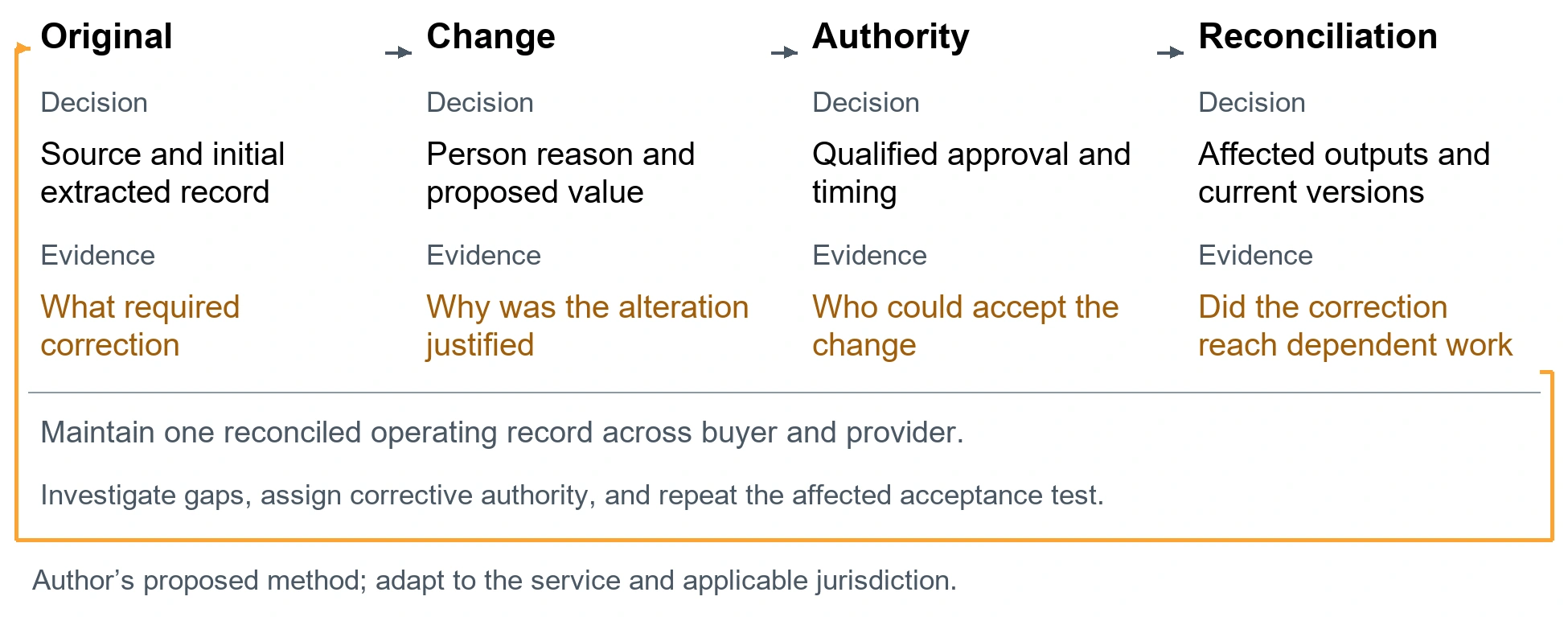
<p>Figure 1 proposes four connected records: original evidence, proposed correction, authorized disposition, and downstream reconciliation. The manager should require identifiers that join the relevant records without unnecessarily duplicating sensitive participant information.</p>
<p>FDA and EMA’s good <a href="https://www.fda.gov/media/189581/download">AI practice principles emphasize traceable provenance and processing decisions.</a><sup id="ref-3"><a href="#note-3" aria-label="Note 3">3</a></sup> The proposed record applies that principle to the two-party correction path. It is not a substitute for applicable GCP, validation, quality, or trial-specific requirements.</p>
<p>Test a correction that affects an already generated summary, table, or submission component. The service should identify affected versions and prevent obsolete material from remaining in use. Correcting one database field does not establish that every dependent artifact has been updated.</p>
<figure><img loading="lazy" src="https://akholi.com/wp-content/uploads/2026/10/077-f1.webp" width="1950" height="767" alt="The clinical correction record. Original. Decision: Source and initial extracted record. Evidence: What required correction. Change. Decision: Person reason and proposed value. Evidence: Why was the alteration justified. Authority. Decision: Qualified approval and timing. Evidence: Who could accept the change. Reconciliation. Decision: Affected outputs and current versions. Evidence: Did the correction reach dependent work. Maintain one reconciled operating record across buyer and provider.. Investigate gaps, assign corrective authority, and repeat the affected acceptance test.. Author’s proposed method; adapt to the service and applicable jurisdiction."><figcaption>Figure 1. The clinical correction record<small><a href="https://akholi.com/outsourcing-2026-agentic-ai-tier-1-banks/">Phil Hatch, proposed framework developed for this paper.</a></small></figcaption></figure>
<h2 id="section-4">Preserve Blinding and Qualified Judgment</h2>
<p>Access to make or review a correction should match the trial’s roles and controls. The manager should involve appropriate clinical, statistical, data-management, and quality owners where a change could affect interpretation or trial integrity. An AI workflow must not bypass restrictions because a tool can technically access the information.</p>
<p>EU, UK, Swiss, US, and other trial, privacy, and records requirements should be assessed for the activity and local implementation. Agree secure sponsor access to relevant CRO and downstream records. A general audit clause is inadequate if records cannot be retrieved or linked when needed.</p>
<p>The commercial model should allow truthful reporting of review effort and corrections. An automation target that discourages disclosure can weaken the sponsor’s understanding of the process. Evaluate accepted quality and intervention transparency separately so that a justified correction is not automatically penalized.</p>
<h2 id="section-5">Accept the Corrected Evidence and the Method</h2>
<p>A reasonable objection is that detailed records will burden routine editorial work. Set proportionate categories. Preserve the history necessary for consequential data and interpretation while avoiding indiscriminate logging of every inconsequential draft adjustment. The distinction should be approved by qualified owners rather than improvised by operators.</p>
<p>Before relying on the workflow, reconstruct representative corrected and uncorrected cases. Verify the original source, authority, timing, reason, resulting value, and downstream reconciliation. Investigate cases that cannot be explained and retest the affected method after remediation.</p>
<p>The manager should accept AI-supported CRO work when the sponsor can understand both the final evidence and the corrections that made it usable. Human judgment can strengthen trial reliability. Its value is undermined when the delivery record hides where it was necessary and what it changed.</p>
<h2 id="section-6">Evidence and Source Note</h2>
<p>The study is a nonrepresentative cross-section of 850 vendor delivery-team <a href="https://akholi.com/outsourcing-2026-agentic-ai-tier-1-banks/introduction/">respondents</a> on 150 engagements serving Tier 1 financial institutions, collected during January–June 2026. Neither banks nor vendors corroborated the accounts. It establishes reported experience, not causation, legal breach, or market prevalence. Its application here is a mechanism to investigate, not an estimate of conditions in other industries. The author-supplied version 1.8.2 is dated November 1, 2026 and is cited as a forthcoming manuscript consulted October 23, 2026.<sup id="ref-4"><a href="#note-4" aria-label="Note 4">4</a></sup></p>
<p>This is an analytical decision paper based on the supplied study and selected primary public sources checked through October 23, 2026. The original contribution is a clinical correction record linking source evidence, human authority, and downstream artifact reconciliation across sponsor and CRO. The proposed method has not been independently validated. Legal requirements depend on the entity, activity, jurisdiction, and effective provisions; supervisory observations, research, and professional commentary have distinct authority.</p>
<h2 id="notes">Notes</h2><ol class="akp-notes"><li id="note-1">International Council for Harmonisation of Technical Requirements for Pharmaceuticals for Human Use, <i>Guideline for Good Clinical Practice E6(R3)</i> (International Council for Harmonisation of Technical Requirements for Pharmaceuticals for Human Use, January 6, 2025), Annex 1, secs. 2.12.2, 3.6.4–3.6.10, and glossary definition of audit trail, <a href="https://database.ich.org/sites/default/files/ICH_E6(R3)_Step4_FinalGuideline_2025_0106.pdf">https://database.ich.org/sites/default/files/ICH_E6(R3)_Step4_FinalGuideline_2025_0106.pdf</a>. <a href="#ref-1" aria-label="Return to note 1">↩</a></li><li id="note-2">Phil Hatch, <i>Agentic AI Outsourcing at Tier 1 Financial Institutions: Full Study Report</i>, version 1.8.2 (Akholi, forthcoming manuscript dated November 1, 2026), Part 5, “The Five Manual Alteration Methods” and “Disclosure of Manual Alteration,” table 5.8, <a href="https://doi.org/10.2139/ssrn.7164559">https://doi.org/10.2139/ssrn.7164559</a>. <a href="#ref-2" aria-label="Return to note 2">↩</a></li><li id="note-3">US Food and Drug Administration and European Medicines Agency, <i>Guiding Principles of Good AI Practice in Drug Development</i> (US Food and Drug Administration and European Medicines Agency, January 2026), principles 2, 4–6, 8–10, <a href="https://www.fda.gov/media/189581/download">https://www.fda.gov/media/189581/download</a>. <a href="#ref-3" aria-label="Return to note 3">↩</a></li><li id="note-4">Hatch, <i>Agentic AI Outsourcing</i>, Introduction, “Executive Summary” and “Evidentiary Basis and Its Limits”. <a href="#ref-4" aria-label="Return to note 4">↩</a></li></ol>
<h2 id="bibliography">Bibliography</h2><ul class="akp-bibliography"><li>Hatch, Phil. <i>Agentic AI Outsourcing at Tier 1 Financial Institutions: Full Study Report</i>. Version 1.8.2. Akholi. Forthcoming manuscript dated November 1, 2026. Author-supplied manuscript consulted October 23, 2026. <a href="https://doi.org/10.2139/ssrn.7164559">https://doi.org/10.2139/ssrn.7164559</a>.</li><li>International Council for Harmonisation of Technical Requirements for Pharmaceuticals for Human Use. <i>Guideline for Good Clinical Practice E6(R3)</i>. International Council for Harmonisation of Technical Requirements for Pharmaceuticals for Human Use, January 6, 2025. <a href="https://database.ich.org/sites/default/files/ICH_E6(R3)_Step4_FinalGuideline_2025_0106.pdf">https://database.ich.org/sites/default/files/ICH_E6(R3)_Step4_FinalGuideline_2025_0106.pdf</a>.</li><li>US Food and Drug Administration and European Medicines Agency. <i>Guiding Principles of Good AI Practice in Drug Development</i>. US Food and Drug Administration and European Medicines Agency, January 2026. <a href="https://www.fda.gov/media/189581/download">https://www.fda.gov/media/189581/download</a>.</li></ul>
