# Local Language and Jurisdiction Tests for Provider Agents

A Management Method for Localized Delivery Acceptance

Author: Phil Hatch
Publisher: Akholi
Paper ID: AAO-072
Published: October 23, 2026
Language: en
Canonical: https://akholi.com/papers/local-language-and-jurisdiction-tests-for-provider-agents/
Audience: Cross-border outsourcing managers and regional service-quality owners

Managers should accept a provider agent separately for the languages and jurisdictions in which it will operate. Translation quality alone does not establish that the service preserves local meaning, applicable rules, customer instructions, and valid escalation.

<h2 id="section-1">Define the Local Service Rather Than the Language Label</h2>
<p>The vendor manager should identify the actual tasks, customers, documents, and actions in each proposed location. A model’s support for a language does not establish that an outsourced service can interpret a local contract, regulatory term, dialect, or instruction correctly in context.</p>
<p>CMA guidance requires businesses using agents <a href="https://www.gov.uk/government/publications/complying-with-consumer-law-when-using-ai-agents/complying-with-consumer-law-when-using-ai-agents">to consider accurate customer information and applicable consumer rights.</a><sup id="ref-1"><a href="#note-1" aria-label="Note 1">1</a></sup> It applies in its UK legal context. The localization task is broader: determine which local obligations and meanings the service must preserve in every intended jurisdiction.</p>
<p>For a hypothetical customer request, a phrase that appears to authorize a transaction in one context may be a request for information in another. The manager should test the actual workflow and affected action rather than accept a generic multilingual benchmark as evidence of valid customer authority.</p>
<h2 id="section-2">Test Meaning Across the Delivery Chain</h2>
<p>Local meaning can be lost during intake, translation, retrieval, reasoning support, tool execution, or customer communication. Identify each conversion and the person responsible for its quality. A fluent final message can conceal a materially wrong interpretation earlier in the workflow.</p>
<p>The <a href="https://akholi.com/outsourcing-2026-agentic-ai-tier-1-banks/part-4-delivery-workforce/">study</a>’s reported knowledge <a href="https://akholi.com/outsourcing-2026-agentic-ai-tier-1-banks/part-5-manual-alteration/">gaps and manual corrections identify a mechanism to examine.</a><sup id="ref-2"><a href="#note-2" aria-label="Note 2">2</a></sup> They do not measure multilingual performance. Ask whether local experts are repairing cases invisibly and whether the service remains reliable when those experts are unavailable.</p>
<p>Build cases around ambiguous instructions, local terminology, dates, currencies, legal entities, mixed-language documents, and exceptional customers. Preserve the approved interpretation and expected action. Use qualified local reviewers, with disagreements resolved by the owner authorized to interpret the relevant requirement.</p>
<h2 id="section-3">Use a Local Acceptance Record</h2>
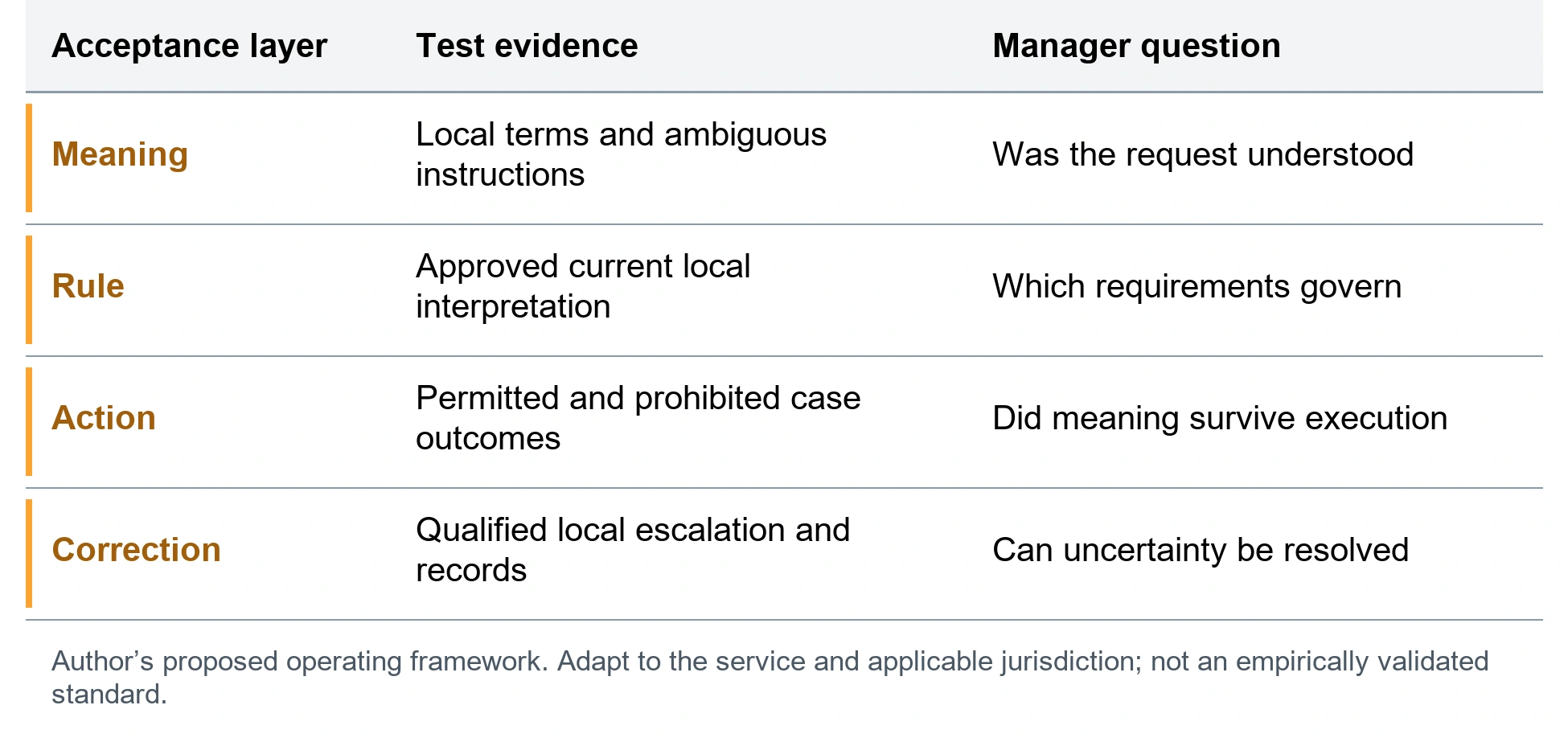
<p>Figure 1 proposes four layers: linguistic meaning, local rule, consequential action, and correction. For each intended combination, record test coverage, evidence, unresolved limitations, and permitted scope. A service may be accepted for information retrieval while remaining restricted from execution.</p>
<p>Include negative tests in which the agent should ask for clarification or refuse to proceed. Measure whether it recognizes an unresolved instruction rather than rewards every completed interaction. Record whether escalation reaches a reviewer who understands the language and has authority over the decision.</p>
<p>Stanford’s deployment playbook <a href="https://digitaleconomy.stanford.edu/app/uploads/2026/03/EnterpriseAIPlaybook_PereiraGraylinBrynjolfsson.pdf">emphasizes matching systems and human oversight to the task.</a><sup id="ref-3"><a href="#note-3" aria-label="Note 3">3</a></sup> Its selected successful cases do not validate any language pair. They support testing the surrounding workflow and expertise rather than assuming language capability transfers unchanged to consequential service delivery.</p>
<figure><img loading="lazy" src="https://akholi.com/wp-content/uploads/2026/10/072-f1.webp" width="1950" height="918" alt="The local delivery acceptance record. Meaning; Local terms and ambiguous instructions; Was the request understood. Rule; Approved current local interpretation; Which requirements govern. Action; Permitted and prohibited case outcomes; Did meaning survive execution. Correction; Qualified local escalation and records; Can uncertainty be resolved. Author’s proposed operating framework. Adapt to the service and applicable jurisdiction; not an empirically validated standard."><figcaption>Figure 1. The local delivery acceptance record<small><a href="https://akholi.com/outsourcing-2026-agentic-ai-tier-1-banks/">Phil Hatch, proposed framework developed for this paper.</a></small></figcaption></figure>
<h2 id="section-4">Maintain Local Rules and Evidence Access</h2>
<p>EU, UK, Swiss, US, and other operations can differ in consumer protection, financial conduct, professional duties, privacy, recordkeeping, and legal effect of communications. Specialists should establish the applicable conclusions. A global instruction should not erase a local restriction or represent uncertain law as settled.</p>
<p>Agree which version of source material governs and how local changes reach the provider. A correct translation of outdated guidance remains an incorrect operating basis. Changes to models, prompts, retrieval sources, or customer groups should reopen the affected local acceptance tests.</p>
<p>Preserve enough source and translation evidence to investigate a contested action while respecting minimization and access requirements. The manager should be able to compare what the customer said, how the service interpreted it, what action occurred, and what explanation was returned.</p>
<h2 id="section-5">Expand Only the Local Scope Demonstrated</h2>
<p>A reasonable objection is that testing every language and jurisdiction is costly. Prioritize combinations by volume, consequence, novelty, and uncertainty. Use common tests where valid, but document the reason for transfer. A low-volume consequential task may still require specialist local assessment.</p>
<p>Before adding a market or action, run representative cases and difficult boundaries through the actual provider configuration. Train the receiving escalation team and test response availability. Restrict unsupported languages or functions visibly rather than allow the agent to improvise local authority.</p>
<p>The manager should approve a defined local service, not a universal language claim. Acceptance is credible when the parties can demonstrate preserved meaning, applicable rules, bounded action, and a usable correction route for the customers and jurisdictions they intend to serve.</p>
<h2 id="section-6">Evidence and Source Note</h2>
<p>The study is a nonrepresentative cross-section of 850 vendor delivery-team <a href="https://akholi.com/outsourcing-2026-agentic-ai-tier-1-banks/introduction/">respondents</a> on 150 engagements serving Tier 1 financial institutions, collected during January–June 2026. Neither banks nor vendors corroborated the accounts. It establishes reported experience, not causation, legal breach, or market prevalence. Its application here is a mechanism to investigate, not an estimate of conditions in other industries. The author-supplied version 1.8.2 is dated November 1, 2026 and is cited as a forthcoming manuscript consulted October 23, 2026.<sup id="ref-4"><a href="#note-4" aria-label="Note 4">4</a></sup></p>
<p>This is an analytical decision paper based on the supplied study and selected primary public sources checked through October 23, 2026. The original contribution is a local-delivery acceptance record separating language fluency from jurisdiction-specific meaning, authority, and operating support. The proposed method has not been independently validated. Legal requirements depend on the entity, activity, jurisdiction, and effective provisions; supervisory observations, research, and professional commentary have distinct authority.</p>
<h2 id="notes">Notes</h2><ol class="akp-notes"><li id="note-1">Competition and Markets Authority, “Complying with Consumer Law When Using AI Agents,” Competition and Markets Authority, March 9, 2026, “When it comes to dealing with your customers” and “Monitor how your AI agents are performing”, <a href="https://www.gov.uk/government/publications/complying-with-consumer-law-when-using-ai-agents/complying-with-consumer-law-when-using-ai-agents">https://www.gov.uk/government/publications/complying-with-consumer-law-when-using-ai-agents/complying-with-consumer-law-when-using-ai-agents</a>. <a href="#ref-1" aria-label="Return to note 1">↩</a></li><li id="note-2">Phil Hatch, <i>Agentic AI Outsourcing at Tier 1 Financial Institutions: Full Study Report</i>, version 1.8.2 (Akholi, forthcoming manuscript dated November 1, 2026), Part 4, “Knowledge at Risk of Departure”, <a href="https://doi.org/10.2139/ssrn.7164559">https://doi.org/10.2139/ssrn.7164559</a>; Hatch, <i>Agentic AI Outsourcing</i>, Part 5, “The Five Manual Alteration Methods” and “Disclosure of Manual Alteration,” table 5.8. <a href="#ref-2" aria-label="Return to note 2">↩</a></li><li id="note-3">Elisa Pereira et al., <i>The Enterprise AI Playbook: Lessons from 51 Successful Deployments,</i> Stanford Digital Economy Lab, April 2026, methodology and chapters 1–3 and 8; purposive successful-case sample, <a href="https://digitaleconomy.stanford.edu/app/uploads/2026/03/EnterpriseAIPlaybook_PereiraGraylinBrynjolfsson.pdf">https://digitaleconomy.stanford.edu/app/uploads/2026/03/EnterpriseAIPlaybook_PereiraGraylinBrynjolfsson.pdf</a>. <a href="#ref-3" aria-label="Return to note 3">↩</a></li><li id="note-4">Hatch, <i>Agentic AI Outsourcing</i>, Introduction, “Executive Summary” and “Evidentiary Basis and Its Limits”. <a href="#ref-4" aria-label="Return to note 4">↩</a></li></ol>
<h2 id="bibliography">Bibliography</h2><ul class="akp-bibliography"><li>Competition and Markets Authority. “Complying with Consumer Law When Using AI Agents.” Competition and Markets Authority. March 9, 2026. <a href="https://www.gov.uk/government/publications/complying-with-consumer-law-when-using-ai-agents/complying-with-consumer-law-when-using-ai-agents">https://www.gov.uk/government/publications/complying-with-consumer-law-when-using-ai-agents/complying-with-consumer-law-when-using-ai-agents</a>.</li><li>Hatch, Phil. <i>Agentic AI Outsourcing at Tier 1 Financial Institutions: Full Study Report</i>. Version 1.8.2. Akholi. Forthcoming manuscript dated November 1, 2026. Author-supplied manuscript consulted October 23, 2026. <a href="https://doi.org/10.2139/ssrn.7164559">https://doi.org/10.2139/ssrn.7164559</a>.</li><li>Pereira, Elisa, Alvin Wang Graylin, and Erik Brynjolfsson. <i>The Enterprise AI Playbook: Lessons from 51 Successful Deployments.</i> Stanford Digital Economy Lab. April 2026. <a href="https://digitaleconomy.stanford.edu/app/uploads/2026/03/EnterpriseAIPlaybook_PereiraGraylinBrynjolfsson.pdf">https://digitaleconomy.stanford.edu/app/uploads/2026/03/EnterpriseAIPlaybook_PereiraGraylinBrynjolfsson.pdf</a>.</li></ul>
