The executive sponsor should require a precise account of what will enter production: tasks, users, tools, data, permissions, human roles, and operating limits. A demonstration can show useful capability while excluding difficult cases, live-system constraints, and the buyer decisions on which reliable delivery depends.
BCG’s regulated-industry platform discussion emphasizes reusable technical controls and operating discipline.1 These are architectural recommendations, not proof that a particular service is ready. The executive needs evidence from the assembled buyer-provider workflow under the conditions it will encounter.
Define the minimum acceptable outcome and the authority required to produce it. Identify actions that remain prohibited, cases that require review, and conditions that cause work to pause. Approval should attach to this scope and configuration rather than to a broad label such as an AI-enabled service.
The study describes processes and organizations insufficiently adapted to agentic delivery.2 A supplier can meet its own readiness checklist while waiting on unavailable buyer approvers, inaccessible data, or incompatible tools. Production readiness therefore belongs to the joint operating model.
For a hypothetical procurement service, the provider may correctly identify an exception but need an authorized buyer to resolve it before an order deadline. The readiness test should establish who receives the case, what information is available, and whether the decision can be made in time.
Test normal, difficult, rejected, manually corrected, interrupted, and recovered work. Observe the resulting business state. A tool acknowledgement should not become acceptance of an outcome that neither firm has reconciled. Record the limitations of test data and any significant production condition not represented.
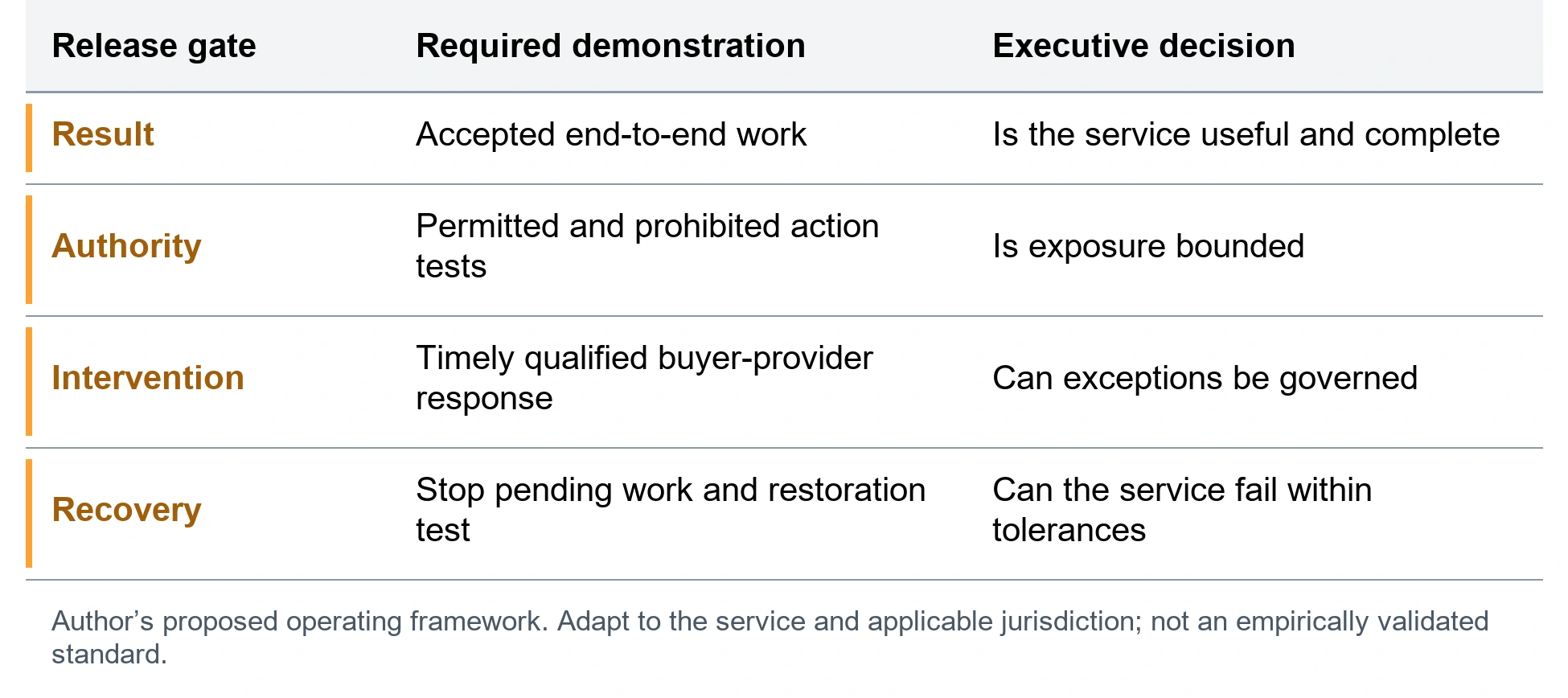
Figure 1 proposes four evidence gates: result, authority, intervention, and recovery. Assign a buyer and provider owner for each. Record the tested configuration, acceptance criteria, findings, unresolved limitations, and the person authorized to accept residual risk.
Include the human work that makes the service function. Review staffing, training, review capacity, decision access, and escalation coverage. An apparently automated workflow may depend on specialists who were available during the pilot but are not funded or scheduled for live operation.
Stanford’s selected successful deployment cases emphasize complementary organizational work.3 The cases do not estimate a general success rate. They support evaluating the capabilities surrounding the technology rather than treating model performance as a complete production decision.
Conditional approval should specify enforceable limits: permitted volume, action scope, case types, review requirements, expiry, and retest triggers. An unresolved issue should have a named owner and decision date. A condition that no system or operating team implements does not constrain production exposure.
Applicable EU, UK, Swiss, US, and other obligations should be assessed for the actual activity and entity. Production authorization, contractual acceptance, regulatory approval where required, and internal risk acceptance are separate decisions. One should not be represented as automatically satisfying the others.
The provider should disclose material dependencies and change triggers. A later update to the model, instructions, tools, data route, or subcontractor can invalidate part of the readiness evidence. Agree which changes remain within approved scope and which require renewed acceptance.
A reasonable objection is that waiting for complete certainty prevents useful deployment. Readiness does not require certainty. It requires an explicit, proportionate decision about the demonstrated service, remaining uncertainty, and the controls that limit consequences while learning continues.
Before launch, have both firms complete a bounded end-to-end exercise and an interruption scenario. Require operations to reconcile pending work and demonstrate escalation, stop, and recovery. The executive should see a concise recommendation with the evidence route and limitations, not an unqualified readiness score.
Approve the service at the scope the evidence supports. Expand only when the joint operating model can sustain the additional authority and workload. This approach makes production readiness a defensible decision about deliverable outcomes rather than a ceremonial final step after the commercial commitment.
The study is a nonrepresentative cross-section of 850 vendor delivery-team respondents on 150 engagements serving Tier 1 financial institutions, collected during January–June 2026. Neither banks nor vendors corroborated the accounts. It establishes reported experience, not causation, legal breach, or market prevalence. Its application here is a mechanism to investigate, not an estimate of conditions in other industries. The author-supplied version 1.8.2 is dated November 1, 2026 and is cited as a forthcoming manuscript consulted October 23, 2026.4
This is an analytical decision paper based on the supplied study and selected primary public sources checked through October 23, 2026. The original contribution is a joint production-readiness record that separates demonstrated scope from enforceable conditions and future expansion. The proposed method has not been independently validated. Legal requirements depend on the entity, activity, jurisdiction, and effective provisions; supervisory observations, research, and professional commentary have distinct authority.