# Reconstructing Agent Actions Across Buyer and Provider Systems

A Management Method for One Defensible Case History

Author: Phil Hatch
Publisher: Akholi
Paper ID: AAO-064
Published: October 23, 2026
Language: en
Canonical: https://akholi.com/papers/reconstructing-agent-actions-across-buyer-and-provider-systems/
Audience: Vendor assurance managers and outsourced-service control owners

Vendor managers should require a reconstructable case history across both firms. A useful record connects the initiating instruction, delegated authority, relevant configuration, tool actions, human corrections, and independently observed result without collecting unnecessary internal reasoning.

<h2 id="section-1">Reconstruct the Business Action</h2>
<p>The delivery manager should start with an important completed case and ask another authorized reviewer to explain what happened. The objective is not to store every internal model calculation. It is to establish the instruction, authority, material inputs, actions, changes, and resulting business state.</p>
<p>NIST’s <a href="https://www.nist.gov/blogs/cybersecurity-insights/back-future-why-agentic-ai-needs-strong-identity-foundation">identity discussion explains why shared credentials obscure agent attribution.</a><sup id="ref-1"><a href="#note-1" aria-label="Note 1">1</a></sup> Identity is one part of reconstruction. The manager also needs a case identifier that remains usable across buyer and provider records and a consistent way to distinguish an attempted action from an accepted result.</p>
<p>A hypothetical payment instruction may cross a buyer interface, a provider orchestrator, a model service, and a bank tool. Each can record success for its own step while the intended payment remains incomplete. The case history should reveal which authoritative event establishes the outcome.</p>
<h2 id="section-2">Connect Records Without Pretending They Are Identical</h2>
<p>The <a href="https://akholi.com/outsourcing-2026-agentic-ai-tier-1-banks/part-2-five-failure-categories/">study</a> reports fragmented visibility <a href="https://akholi.com/outsourcing-2026-agentic-ai-tier-1-banks/part-3-governance-oversight-control/">and completion signals that could differ from actual results.</a><sup id="ref-2"><a href="#note-2" aria-label="Note 2">2</a></sup> These observations identify a practical question: can the buyer reconcile the evidence from both firms, including the human work that changes the case after the agent stops?</p>
<p>Define the shared case reference, event types, time source, system identifiers, and version references. Record retries and partial failures. A separate identifier may be needed for each attempt, but it should remain linked to the same business intent so that repeated execution is not mistaken for new authorized work.</p>
<p>Retain the original and corrected states where material. An edited final record can hide the reason for an exception or make a later action appear to have preceded approval. Corrections should add an attributable event and explanation rather than erase the history needed to understand the result.</p>
<h2 id="section-3">Use a Cross Firm Reconstruction Record</h2>
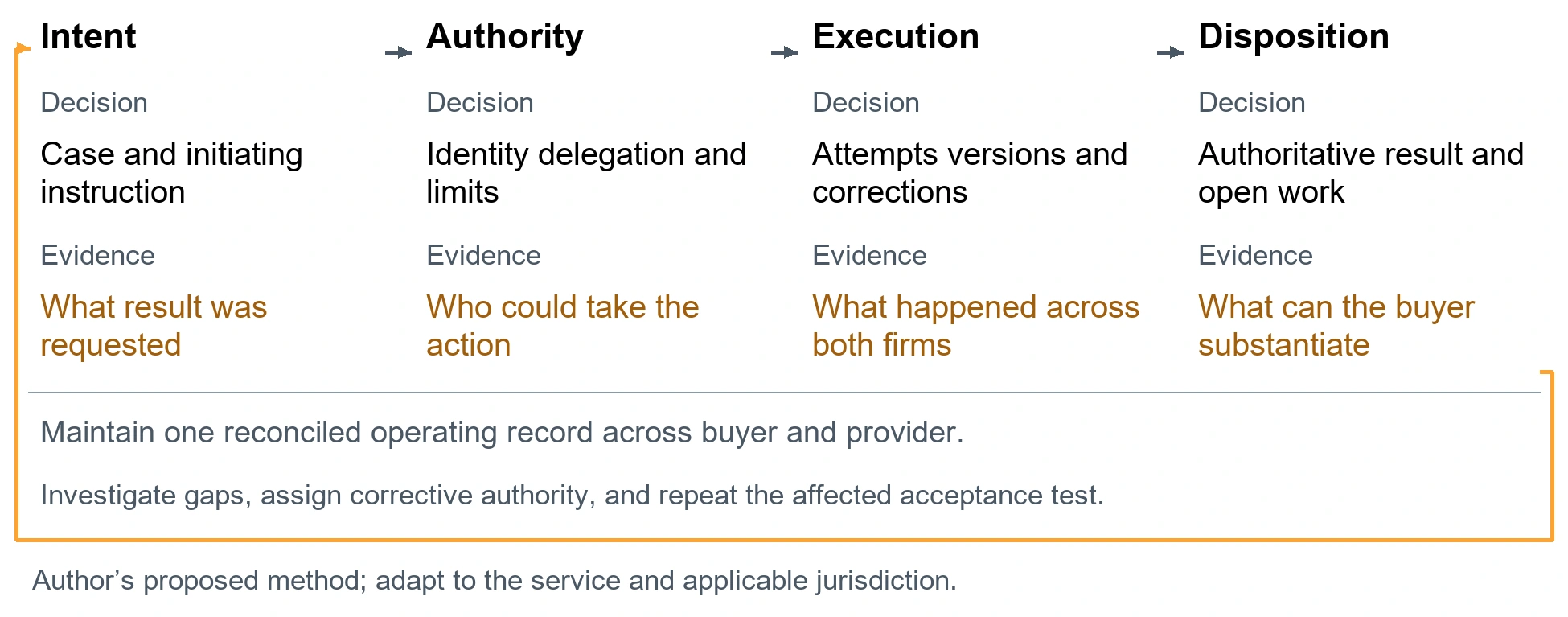
<p>Figure 1 proposes four linked layers: intent, authority, execution, and disposition. The first establishes the requested business result. The second identifies who could act and under what limits. The third records consequential attempts and interventions. The fourth reconciles the final state and unresolved obligations.</p>
<p>Choose evidence according to the decision it must support. Relevant tool inputs and outputs may matter; unrestricted collection of sensitive prompts or internal reasoning may be unnecessary or inappropriate. Security, privacy, legal, and operational owners should agree access, minimization, integrity, and retention.</p>
<p><a href="https://www.mayerbrown.com/en/insights/publications/2026/02/contracting-for-agentic-ai-solutions-shifting-the-model-from-saas-to-services">Mayer Brown</a>’s agentic contracting analysis emphasizes defined authority and service accountability.<sup id="ref-3"><a href="#note-3" aria-label="Note 3">3</a></sup> Translate those terms into an evidence obligation with a usable retrieval process. A broad audit right provides little immediate help if the relevant records cannot be joined or obtained within the investigation window.</p>
<figure><img loading="lazy" src="https://akholi.com/wp-content/uploads/2026/10/064-f1.webp" width="1950" height="767" alt="The cross firm reconstruction record. Intent. Decision: Case and initiating instruction. Evidence: What result was requested. Authority. Decision: Identity delegation and limits. Evidence: Who could take the action. Execution. Decision: Attempts versions and corrections. Evidence: What happened across both firms. Disposition. Decision: Authoritative result and open work. Evidence: What can the buyer substantiate. Maintain one reconciled operating record across buyer and provider.. Investigate gaps, assign corrective authority, and repeat the affected acceptance test.. Author’s proposed method; adapt to the service and applicable jurisdiction."><figcaption>Figure 1. The cross firm reconstruction record<small><a href="https://akholi.com/outsourcing-2026-agentic-ai-tier-1-banks/">Phil Hatch, proposed framework developed for this paper.</a></small></figcaption></figure>
<h2 id="section-4">Test Retrieval Under Real Operating Constraints</h2>
<p>Ask the provider to retrieve representative successful, failed, retried, manually corrected, and contested cases. Reconcile them to the buyer’s authoritative systems. Record missing links and whether the limitation changes acceptance, incident classification, invoice treatment, or the ability to explain an action to an affected person.</p>
<p>Across EU, UK, Swiss, US, and other operations, determine applicable recordkeeping, privacy, secrecy, and cross-border access conditions. The parties should establish a secure route for authorized investigation. Do not assume that contractual ownership of data permits unrestricted distribution of every case record.</p>
<p>Repeat the exercise after changes to orchestration, logging, tools, identity, or retention. Evidence can disappear because one subcontractor shortens a retention period even when the primary application remains unchanged. The manager should know which dependency can break reconstruction and who must notify the buyer.</p>
<h2 id="section-5">Make Reconstruction a Service Acceptance Condition</h2>
<p>A reasonable objection is that complete traceability costs too much. Set proportionate requirements for the service’s consequences and legal obligations. Capture the material action chain by design rather than assemble an unrestricted archive. A small coherent record can be more useful than a large collection of disconnected logs.</p>
<p>Before accepting the service, have a reviewer who did not execute the case reconstruct its relevant history from the agreed records. Time the retrieval and document ambiguity. Where a material action cannot be explained, fix the evidence route or restrict that action before scaling delivery.</p>
<p>The manager should be able to answer what was requested, who could act, what occurred, what humans changed, and which result remains. That is the operational purpose of reconstruction. A collection of logs becomes evidence only when it can support those answers reliably across the two firms.</p>
<h2 id="section-6">Evidence and Source Note</h2>
<p>The study is a nonrepresentative cross-section of 850 vendor delivery-team <a href="https://akholi.com/outsourcing-2026-agentic-ai-tier-1-banks/introduction/">respondents</a> on 150 engagements serving Tier 1 financial institutions, collected during January–June 2026. Neither banks nor vendors corroborated the accounts. It establishes reported experience, not causation, legal breach, or market prevalence. Its application here is a mechanism to investigate, not an estimate of conditions in other industries. The author-supplied version 1.8.2 is dated November 1, 2026 and is cited as a forthcoming manuscript consulted October 23, 2026.<sup id="ref-4"><a href="#note-4" aria-label="Note 4">4</a></sup></p>
<p>This is an analytical decision paper based on the supplied study and selected primary public sources checked through October 23, 2026. The original contribution is a cross-firm case reconstruction method focused on material business actions rather than unrestricted collection of model reasoning. The proposed method has not been independently validated. Legal requirements depend on the entity, activity, jurisdiction, and effective provisions; supervisory observations, research, and professional commentary have distinct authority.</p>
<h2 id="notes">Notes</h2><ol class="akp-notes"><li id="note-1">Bill Fisher and Ryan Galluzzo, “Back to the Future: Why Agentic AI Needs a Strong Identity Foundation,” National Institute of Standards and Technology, August 27, 2026, “Credential Sharing” and “Static and Long-lived Credentials”, <a href="https://www.nist.gov/blogs/cybersecurity-insights/back-future-why-agentic-ai-needs-strong-identity-foundation">https://www.nist.gov/blogs/cybersecurity-insights/back-future-why-agentic-ai-needs-strong-identity-foundation</a>. <a href="#ref-1" aria-label="Return to note 1">↩</a></li><li id="note-2">Phil Hatch, <i>Agentic AI Outsourcing at Tier 1 Financial Institutions: Full Study Report</i>, version 1.8.2 (Akholi, forthcoming manuscript dated November 1, 2026), Part 2, sec. 5.1, “Agent Actions Visible Only Inside Each Firm’s Own Tools”, <a href="https://doi.org/10.2139/ssrn.7164559">https://doi.org/10.2139/ssrn.7164559</a>; Hatch, <i>Agentic AI Outsourcing</i>, Part 3, AI Technology, sec. 4.1, “Accuracy of the Tools’ Own Success and Failure Reports,” indicator C172. <a href="#ref-2" aria-label="Return to note 2">↩</a></li><li id="note-3">Rohith P. George et al., “Contracting for Agentic AI Solutions: Shifting the Model from SaaS to Services,” Mayer Brown, February 17, 2026, secs. 1–6, <a href="https://www.mayerbrown.com/en/insights/publications/2026/02/contracting-for-agentic-ai-solutions-shifting-the-model-from-saas-to-services">https://www.mayerbrown.com/en/insights/publications/2026/02/contracting-for-agentic-ai-solutions-shifting-the-model-from-saas-to-services</a>. <a href="#ref-3" aria-label="Return to note 3">↩</a></li><li id="note-4">Hatch, <i>Agentic AI Outsourcing</i>, Introduction, “Executive Summary” and “Evidentiary Basis and Its Limits”. <a href="#ref-4" aria-label="Return to note 4">↩</a></li></ol>
<h2 id="bibliography">Bibliography</h2><ul class="akp-bibliography"><li>Fisher, Bill, and Ryan Galluzzo. “Back to the Future: Why Agentic AI Needs a Strong Identity Foundation.” National Institute of Standards and Technology. August 27, 2026. <a href="https://www.nist.gov/blogs/cybersecurity-insights/back-future-why-agentic-ai-needs-strong-identity-foundation">https://www.nist.gov/blogs/cybersecurity-insights/back-future-why-agentic-ai-needs-strong-identity-foundation</a>.</li><li>George, Rohith P., Joe Pennell, Brad L. Peterson, and Oliver Yaros. “Contracting for Agentic AI Solutions: Shifting the Model from SaaS to Services.” Mayer Brown. February 17, 2026. <a href="https://www.mayerbrown.com/en/insights/publications/2026/02/contracting-for-agentic-ai-solutions-shifting-the-model-from-saas-to-services">https://www.mayerbrown.com/en/insights/publications/2026/02/contracting-for-agentic-ai-solutions-shifting-the-model-from-saas-to-services</a>.</li><li>Hatch, Phil. <i>Agentic AI Outsourcing at Tier 1 Financial Institutions: Full Study Report</i>. Version 1.8.2. Akholi. Forthcoming manuscript dated November 1, 2026. Author-supplied manuscript consulted October 23, 2026. <a href="https://doi.org/10.2139/ssrn.7164559">https://doi.org/10.2139/ssrn.7164559</a>.</li></ul>
