# Testing Model Substitution for Banking Service Continuity

A Manager Method for a Usable Alternative

Author: Phil Hatch
Publisher: Akholi
Paper ID: AAO-062
Published: October 23, 2026
Language: en
Canonical: https://akholi.com/papers/testing-model-substitution-for-banking-service-continuity/
Audience: Bank outsourcing continuity managers and vendor-service assurance leads

Bank vendor managers should test model substitution as a service change, not a procurement option. An alternative becomes credible when the bank can move the relevant context, tools, controls, and evidence and complete the critical service within its required tolerance.

<h2 id="section-1">Define What Must Continue</h2>
<p>The vendor manager should identify the critical service outcome before asking whether a second model is available. Access to another endpoint does not establish that it can interpret the bank’s context, call its tools, respect its permissions, or produce records that operations can reconcile.</p>
<p>The Basel Committee’s third-party principles, summarized by the <a href="https://www.bis.org/publications/fsi-summary-sound-management-third-party-risk-executive-summary">FSI, connect critical dependencies with continuity and exit planning.</a><sup id="ref-1"><a href="#note-1" aria-label="Note 1">1</a></sup> Their application is proportionate and jurisdiction dependent. The operational task is to determine whether the bank can sustain its own material service when a model dependency fails or becomes unsuitable.</p>
<p>Define the minimum acceptable service, work priority, recovery window, pending-case treatment, and conditions requiring restricted operation. A slower alternative may be sufficient for some work and unusable for a time-critical transaction. Test against the relevant outcome rather than a general claim of equivalent intelligence.</p>
<h2 id="section-2">Identify the Dependencies That Move with the Model</h2>
<p>Model substitution can affect instructions, tool syntax, context length, output format, refusal behavior, latency, and cost. The provider should identify which service components are portable and which must be rebuilt. Include retrieval permissions, stored context, agent memory, and the evidence needed to resume incomplete work.</p>
<p>The <a href="https://akholi.com/outsourcing-2026-agentic-ai-tier-1-banks/part-3-governance-oversight-control/">study</a> <a href="https://akholi.com/outsourcing-2026-agentic-ai-tier-1-banks/part-3-governance-oversight-control/">describes downstream ecosystem gaps and limited visibility into execution.</a><sup id="ref-2"><a href="#note-2" aria-label="Note 2">2</a></sup> These reported experiences do not prove that substitution is impossible. They make an untested portability statement inadequate evidence for the bank’s continuity decision.</p>
<p>For a hypothetical reconciliation service, another model may generate a valid-looking response while handling an exception differently. The test should verify the resulting account state, exception routing, and retained history. Reproducing the previous wording is less important than preserving the correct financial outcome and authority.</p>
<h2 id="section-3">Use a Substitution Acceptance Record</h2>
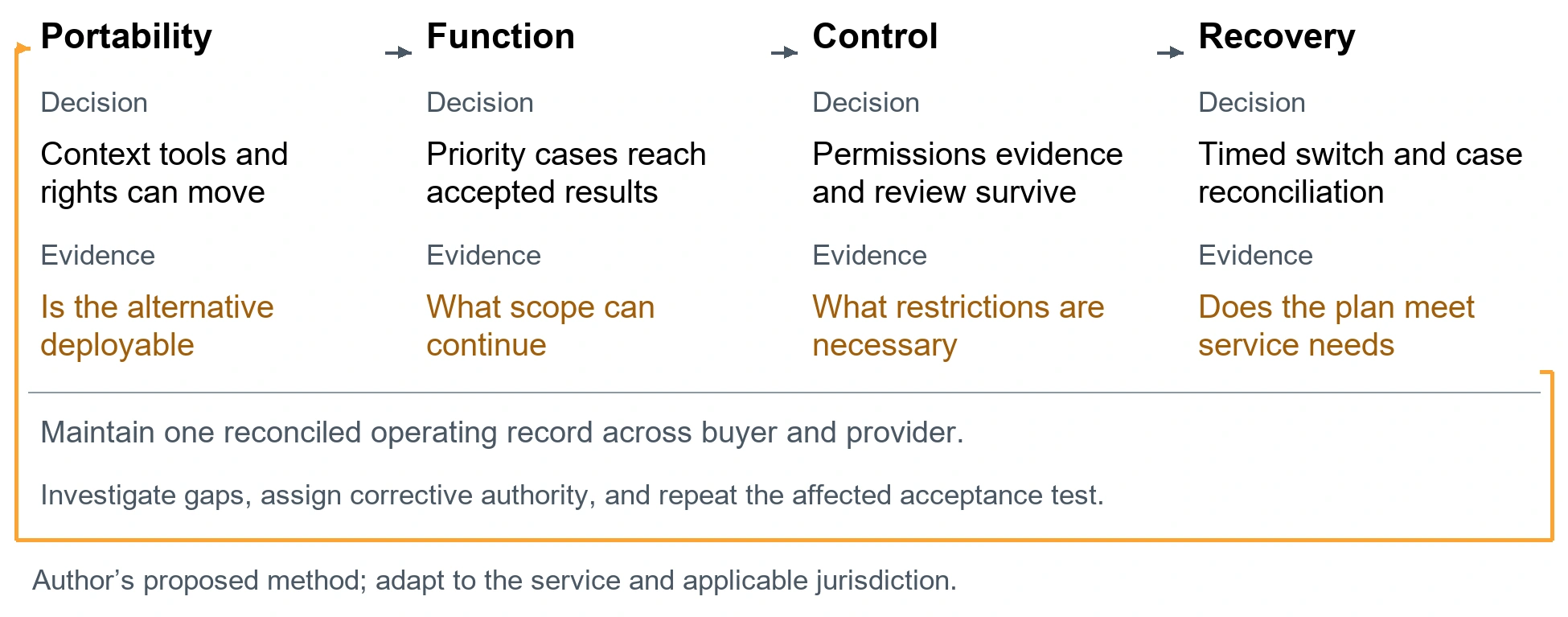
<p>Figure 1 proposes four tests: dependency portability, functional completion, control preservation, and recovery operation. Run the alternative against representative normal and difficult cases using an approved configuration. Record failures and the operational restriction that applies while each remains unresolved.</p>
<p>Measure time from the decision to substitute until the alternative can complete accepted work. Include configuration, access approval, data transfer, evaluation, staff readiness, and pending-case reconciliation. Exclude none of these simply because they occur outside the model provider’s restoration clock.</p>
<p>The FCA’s October 2026 practice examples address <a href="https://www.fca.org.uk/publications/good-poor-practice/ai-financial-services">tested fallbacks, exit capability, and challenge of supplier assurances.</a><sup id="ref-3"><a href="#note-3" aria-label="Note 3">3</a></sup> They create no new requirements. They support asking for demonstrated service continuity rather than an alternative named in a presentation.</p>
<figure><img loading="lazy" src="https://akholi.com/wp-content/uploads/2026/10/062-f1.webp" width="1950" height="767" alt="The model substitution acceptance record. Portability. Decision: Context tools and rights can move. Evidence: Is the alternative deployable. Function. Decision: Priority cases reach accepted results. Evidence: What scope can continue. Control. Decision: Permissions evidence and review survive. Evidence: What restrictions are necessary. Recovery. Decision: Timed switch and case reconciliation. Evidence: Does the plan meet service needs. Maintain one reconciled operating record across buyer and provider.. Investigate gaps, assign corrective authority, and repeat the affected acceptance test.. Author’s proposed method; adapt to the service and applicable jurisdiction."><figcaption>Figure 1. The model substitution acceptance record<small><a href="https://akholi.com/outsourcing-2026-agentic-ai-tier-1-banks/">Phil Hatch, proposed framework developed for this paper.</a></small></figcaption></figure>
<h2 id="section-4">Check Independence and the Right to Move</h2>
<p>An alternative may share the same cloud, identity service, model family, or subcontractor as the primary route. Map the failure scenario it can withstand. A second commercial supplier is not necessarily an independent technical dependency, and a different technical route may still rely on the same unavailable buyer approval.</p>
<p>Legal and sourcing teams should confirm licenses, data-transfer permissions, records access, transition assistance, and restrictions on moving instructions or memory. EU, UK, Swiss, US, and other bank requirements should be assessed for the actual arrangement. A continuity objective does not itself authorize every transfer.</p>
<p>The provider should identify who initiates substitution, who accepts the restricted service, and who can stop it. Retain the old configuration and work history to investigate differences. Returning to the primary route should require reconciliation, not an automatic assumption that temporary work was completed correctly.</p>
<h2 id="section-5">Classify the Alternative Honestly</h2>
<p>A reasonable objection is that maintaining full duplication is expensive. The manager should compare options proportionately: tested model substitution, reduced scope, manual fallback, deferred work, or a separately engineered service. State the residual interruption and cost of each. A plan can be useful without promising uninterrupted equivalence.</p>
<p>Before relying on substitution, conduct a bounded exercise without the primary dependency. Ask operations to complete and reconcile the priority work, including exceptions and corrections. Record the recovery time demonstrated and any resources that would be unavailable in a wider incident.</p>
<p>The continuity decision should distinguish an available model, a configured alternative, and a tested replacement service. Only the last establishes what the bank can continue to deliver. That distinction lets management fund the recovery capability it needs and disclose the limitations it still accepts.</p>
<h2 id="section-6">Evidence and Source Note</h2>
<p>The study is a nonrepresentative cross-section of 850 vendor delivery-team <a href="https://akholi.com/outsourcing-2026-agentic-ai-tier-1-banks/introduction/">respondents</a> on 150 engagements serving Tier 1 financial institutions, collected during January–June 2026. Neither banks nor vendors corroborated the accounts. It establishes reported experience, not causation, legal breach, or market prevalence. The author-supplied version 1.8.2 is dated November 1, 2026 and is cited as a forthcoming manuscript consulted October 23, 2026.<sup id="ref-4"><a href="#note-4" aria-label="Note 4">4</a></sup></p>
<p>This is an analytical decision paper based on the supplied study and selected primary public sources checked through October 23, 2026. The original contribution is a banking model-substitution test separating endpoint availability from configured, controlled, and timed service continuity. The proposed method has not been independently validated. Legal requirements depend on the entity, activity, jurisdiction, and effective provisions; supervisory observations, research, and professional commentary have distinct authority.</p>
<h2 id="notes">Notes</h2><ol class="akp-notes"><li id="note-1">Bank for International Settlements, Financial Stability Institute, “Sound Management of Third-Party Risk—Executive Summary,” Bank for International Settlements, Financial Stability Institute, March 25, 2026, principles 1–9 and intended application, <a href="https://www.bis.org/publications/fsi-summary-sound-management-third-party-risk-executive-summary">https://www.bis.org/publications/fsi-summary-sound-management-third-party-risk-executive-summary</a>. <a href="#ref-1" aria-label="Return to note 1">↩</a></li><li id="note-2">Phil Hatch, <i>Agentic AI Outsourcing at Tier 1 Financial Institutions: Full Study Report</i>, version 1.8.2 (Akholi, forthcoming manuscript dated November 1, 2026), Part 3, Third-Party Ecosystem, sec. 6.1, “Mapping of Third and Fourth Party Dependencies,” indicator C196, <a href="https://doi.org/10.2139/ssrn.7164559">https://doi.org/10.2139/ssrn.7164559</a>; Hatch, <i>Agentic AI Outsourcing</i>, Part 3, AI Technology, sec. 4.1, “Accuracy of the Tools’ Own Success and Failure Reports,” indicator C172. <a href="#ref-2" aria-label="Return to note 2">↩</a></li><li id="note-3">Financial Conduct Authority, “AI in Financial Services: Good Practice and Areas for Improvement,” Financial Conduct Authority, October 19, 2026; updated October 20, 2026, secs. 1.2, 2, 3.4 and 4.2; illustrative practices, not new requirements, <a href="https://www.fca.org.uk/publications/good-poor-practice/ai-financial-services">https://www.fca.org.uk/publications/good-poor-practice/ai-financial-services</a>. <a href="#ref-3" aria-label="Return to note 3">↩</a></li><li id="note-4">Hatch, <i>Agentic AI Outsourcing</i>, Introduction, “Executive Summary” and “Evidentiary Basis and Its Limits”. <a href="#ref-4" aria-label="Return to note 4">↩</a></li></ol>
<h2 id="bibliography">Bibliography</h2><ul class="akp-bibliography"><li>Bank for International Settlements, Financial Stability Institute. “Sound Management of Third-Party Risk—Executive Summary.” Bank for International Settlements, Financial Stability Institute. March 25, 2026. <a href="https://www.bis.org/publications/fsi-summary-sound-management-third-party-risk-executive-summary">https://www.bis.org/publications/fsi-summary-sound-management-third-party-risk-executive-summary</a>.</li><li>Financial Conduct Authority. “AI in Financial Services: Good Practice and Areas for Improvement.” Financial Conduct Authority. October 19, 2026; updated October 20, 2026. <a href="https://www.fca.org.uk/publications/good-poor-practice/ai-financial-services">https://www.fca.org.uk/publications/good-poor-practice/ai-financial-services</a>.</li><li>Hatch, Phil. <i>Agentic AI Outsourcing at Tier 1 Financial Institutions: Full Study Report</i>. Version 1.8.2. Akholi. Forthcoming manuscript dated November 1, 2026. Author-supplied manuscript consulted October 23, 2026. <a href="https://doi.org/10.2139/ssrn.7164559">https://doi.org/10.2139/ssrn.7164559</a>.</li></ul>
