# Claims Automation Must Preserve the Customer’s Route to Challenge

A Manager Method for Outsourced Insurance Decisions

Author: Phil Hatch
Publisher: Akholi
Paper ID: AAO-054
Published: October 23, 2026
Language: en
Canonical: https://akholi.com/papers/claims-automation-must-preserve-the-customer-s-route-to-challenge/
Audience: Insurance claims outsourcing managers and conduct-control leads

Insurance claims managers should preserve an effective route to challenge provider-agent actions. The case record, reasons, qualified authority, and correction process must remain accessible when a customer disputes the outcome.

<h2 id="section-1">Design Challenge into the Claims Service</h2>
<p>The claims manager should define how a customer can question a material action and reach a function able to change the result. The route should cover more than a formal denial. Requests for evidence, delay, valuation, partial payment, and closure can affect the customer even when no final rejection is recorded.</p>
<p>EIOPA’s AI opinion addresses <a href="https://www.eiopa.europa.eu/publications/opinion-artificial-intelligence-governance-and-risk-management_en">governance and risk management through a proportionate supervisory approach.</a><sup id="ref-1"><a href="#note-1" aria-label="Note 1">1</a></sup> It does not establish one universal claims-appeal process. The insurer should identify the applicable local duties and implement a practical challenge route in the outsourced workflow.</p>
<p>Start with the actions the provider may prepare, recommend, or execute. Identify which decisions require insurer or qualified specialist authority. A broad permission to automate claims should not silently authorize the supplier to remove access to review or redefine the evidence necessary for a customer to proceed.</p>
<h2 id="section-2">Preserve the Record Behind the Outcome</h2>
<p>The reviewer should be able to establish the policy terms, customer information, evidence considered, relevant versions, decision basis, and unresolved uncertainty. An agent’s narrative may explain a proposed result but should not replace the underlying support. Preserve material manual changes and the authority under which they were made.</p>
<p>The <a href="https://akholi.com/outsourcing-2026-agentic-ai-tier-1-banks/part-5-manual-alteration/">study</a> <a href="https://akholi.com/outsourcing-2026-agentic-ai-tier-1-banks/part-2-five-failure-categories/">reports manual alteration and fragmented visibility across banking delivery.</a><sup id="ref-2"><a href="#note-2" aria-label="Note 2">2</a></sup> It does not measure insurance claims failures. The transferable test is whether a person reviewing the insurer’s own case can reconstruct what the supplier did and distinguish agent preparation from human decision.</p>
<p>For a hypothetical property claim, the supplier may misread an exclusion or omit evidence supporting coverage. The challenge route should allow the customer to provide the missing material and a qualified reviewer to reassess the case. Repeating the original automated explanation would not resolve the disputed basis.</p>
<h2 id="section-3">Use a Challenge and Correction Record</h2>
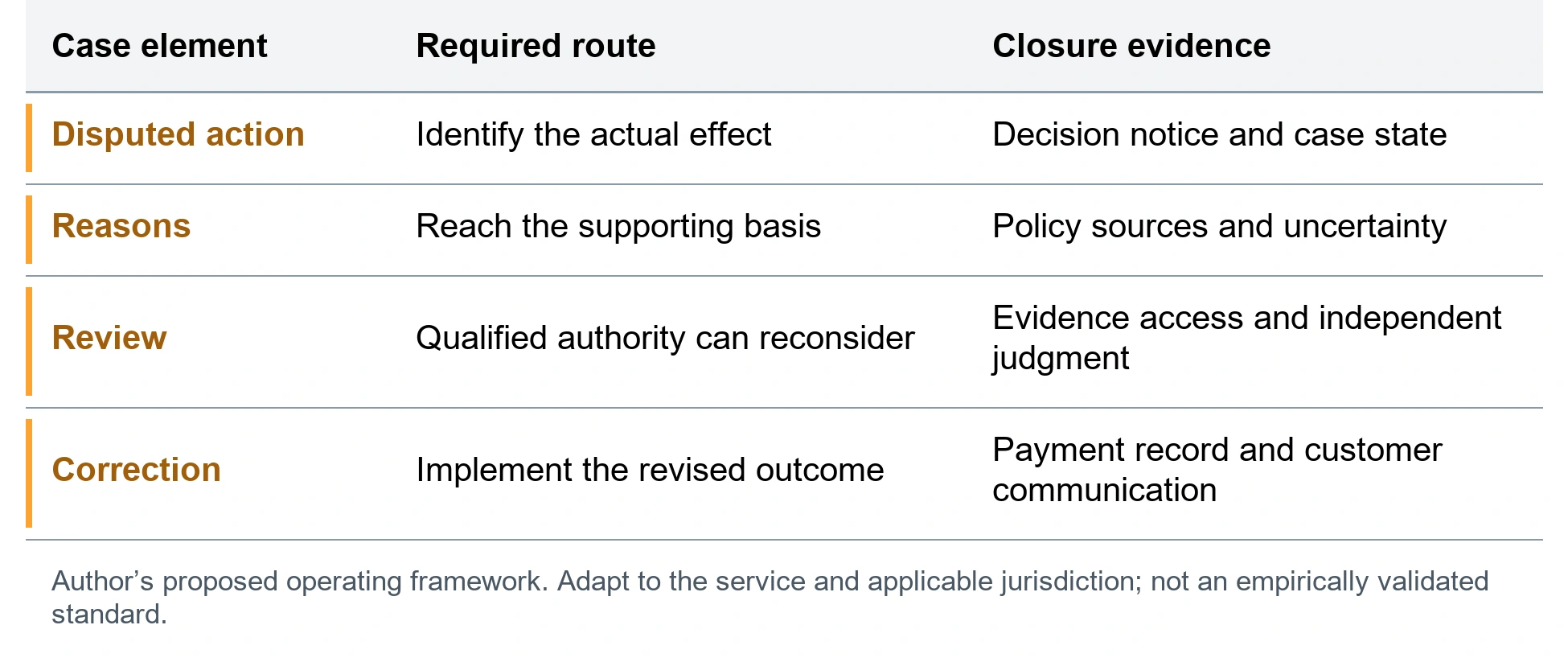
<p>Figure 1 proposes a record linking the disputed action, reason, review authority, and final correction. Preserve the customer’s submission and the case chronology. The service should distinguish an acknowledgment, a referral, a substantive review, and a resolved outcome rather than count each contact as successful support.</p>
<p>Test customers with language, accessibility, vulnerability, and digital-capability needs relevant to the service. The process should not require a person to understand the supplier’s organizational structure to reach the right reviewer. Monitor failed handoffs and unresolved work alongside response-time measures.</p>
<p>The FCA’s practice review emphasizes records, explanations, <a href="https://www.fca.org.uk/publications/good-poor-practice/ai-financial-services">and support that allow AI outcomes to be challenged.</a><sup id="ref-3"><a href="#note-3" aria-label="Note 3">3</a></sup> Applied to the insurer’s contract, the provider should supply timely evidence and cooperation rather than control the only route through which its own work can be questioned.</p>
<figure><img loading="lazy" src="https://akholi.com/wp-content/uploads/2026/10/054-f1.webp" width="1950" height="818" alt="The claims challenge and correction record. Disputed action; Identify the actual effect; Decision notice and case state. Reasons; Reach the supporting basis; Policy sources and uncertainty. Review; Qualified authority can reconsider; Evidence access and independent judgment. Correction; Implement the revised outcome; Payment record and customer communication. Author’s proposed operating framework. Adapt to the service and applicable jurisdiction; not an empirically validated standard."><figcaption>Figure 1. The claims challenge and correction record<small><a href="https://akholi.com/outsourcing-2026-agentic-ai-tier-1-banks/">Phil Hatch, proposed framework developed for this paper.</a></small></figcaption></figure>
<h2 id="section-4">Keep Local Rights and Professional Authority Explicit</h2>
<p>EU, UK, Swiss, US, and other insurance, complaints, privacy, and consumer requirements differ. The manager should maintain a local applicability record for notices, review, timing, reasons, records, and remedies. A group customer-service target can support those duties but should not replace them.</p>
<p>The contract should identify who may suspend an action, authorize an interim measure, correct a payment, or communicate a revised decision. Commercial liability disputes should be recorded separately from urgent authorized customer protection. A provider credit paid later does not resolve an incorrect claim outcome.</p>
<p>Preserve privacy and confidentiality during review. Share the evidence necessary for the authorized decision through appropriate controls. A general supplier-confidentiality assertion should not substitute for assessing what the insurer and customer are entitled to receive under the applicable process.</p>
<h2 id="section-5">Accept the Route Through Contested Cases</h2>
<p>A reasonable objection is that challenge can increase handling costs and weaken automation savings. Those costs belong in the real service economics. Better initial decisions and clearer evidence may reduce avoidable disputes, but the insurer should not improve its cost measure by making valid challenge impractical.</p>
<p>Before launch or expansion, test an erroneous decision, missing evidence, a failed referral, and a corrected outcome. Record whether the reviewer had the evidence and authority needed to resolve the issue. Use the findings to change the workflow, support capacity, and acceptance conditions.</p>
<p>The manager should approve automation when the customer can obtain meaningful review and the insurer can complete the correction. A fast claim process is valuable only within the required standards of decision and recourse. The supplier boundary should not become the point at which the customer loses a usable route to challenge.</p>
<h2 id="section-6">Evidence and Source Note</h2>
<p>The study is a nonrepresentative cross-section of 850 vendor delivery-team <a href="https://akholi.com/outsourcing-2026-agentic-ai-tier-1-banks/introduction/">respondents</a> on 150 engagements serving Tier 1 financial institutions, collected during January–June 2026. Neither banks nor vendors corroborated the accounts. It establishes reported experience, not causation, legal breach, or market prevalence. The author-supplied version 1.8.2 is dated November 1, 2026 and is cited as a forthcoming manuscript consulted October 23, 2026.<sup id="ref-4"><a href="#note-4" aria-label="Note 4">4</a></sup></p>
<p>This is an analytical decision paper based on the supplied study and selected primary public sources checked through October 23, 2026. The original contribution is an insurance claims challenge record connecting disputed supplier actions to source evidence, qualified review, and completed customer correction. The proposed method has not been independently validated. Legal requirements depend on the entity, activity, jurisdiction, and effective provisions; supervisory observations, research, and professional commentary have distinct authority.</p>
<h2 id="notes">Notes</h2><ol class="akp-notes"><li id="note-1">European Insurance and Occupational Pensions Authority, “Opinion on Artificial Intelligence Governance and Risk Management,” European Insurance and Occupational Pensions Authority, August 6, 2025, description and opinion scope; addressed to national supervisors, <a href="https://www.eiopa.europa.eu/publications/opinion-artificial-intelligence-governance-and-risk-management_en">https://www.eiopa.europa.eu/publications/opinion-artificial-intelligence-governance-and-risk-management_en</a>. <a href="#ref-1" aria-label="Return to note 1">↩</a></li><li id="note-2">Phil Hatch, <i>Agentic AI Outsourcing at Tier 1 Financial Institutions: Full Study Report</i>, version 1.8.2 (Akholi, forthcoming manuscript dated November 1, 2026), Part 5, “The Five Manual Alteration Methods” and “Disclosure of Manual Alteration,” table 5.8, <a href="https://doi.org/10.2139/ssrn.7164559">https://doi.org/10.2139/ssrn.7164559</a>; Hatch, <i>Agentic AI Outsourcing</i>, Part 2, sec. 5.1, “Agent Actions Visible Only Inside Each Firm’s Own Tools”. <a href="#ref-2" aria-label="Return to note 2">↩</a></li><li id="note-3">Financial Conduct Authority, “AI in Financial Services: Good Practice and Areas for Improvement,” Financial Conduct Authority, October 19, 2026; updated October 20, 2026, secs. 1.2, 2, 3.4 and 4.2; illustrative practices, not new requirements, <a href="https://www.fca.org.uk/publications/good-poor-practice/ai-financial-services">https://www.fca.org.uk/publications/good-poor-practice/ai-financial-services</a>. <a href="#ref-3" aria-label="Return to note 3">↩</a></li><li id="note-4">Hatch, <i>Agentic AI Outsourcing</i>, Introduction, “Executive Summary” and “Evidentiary Basis and Its Limits”. <a href="#ref-4" aria-label="Return to note 4">↩</a></li></ol>
<h2 id="bibliography">Bibliography</h2><ul class="akp-bibliography"><li>European Insurance and Occupational Pensions Authority. “Opinion on Artificial Intelligence Governance and Risk Management.” European Insurance and Occupational Pensions Authority. August 6, 2025. <a href="https://www.eiopa.europa.eu/publications/opinion-artificial-intelligence-governance-and-risk-management_en">https://www.eiopa.europa.eu/publications/opinion-artificial-intelligence-governance-and-risk-management_en</a>.</li><li>Financial Conduct Authority. “AI in Financial Services: Good Practice and Areas for Improvement.” Financial Conduct Authority. October 19, 2026; updated October 20, 2026. <a href="https://www.fca.org.uk/publications/good-poor-practice/ai-financial-services">https://www.fca.org.uk/publications/good-poor-practice/ai-financial-services</a>.</li><li>Hatch, Phil. <i>Agentic AI Outsourcing at Tier 1 Financial Institutions: Full Study Report</i>. Version 1.8.2. Akholi. Forthcoming manuscript dated November 1, 2026. Author-supplied manuscript consulted October 23, 2026. <a href="https://doi.org/10.2139/ssrn.7164559">https://doi.org/10.2139/ssrn.7164559</a>.</li></ul>
