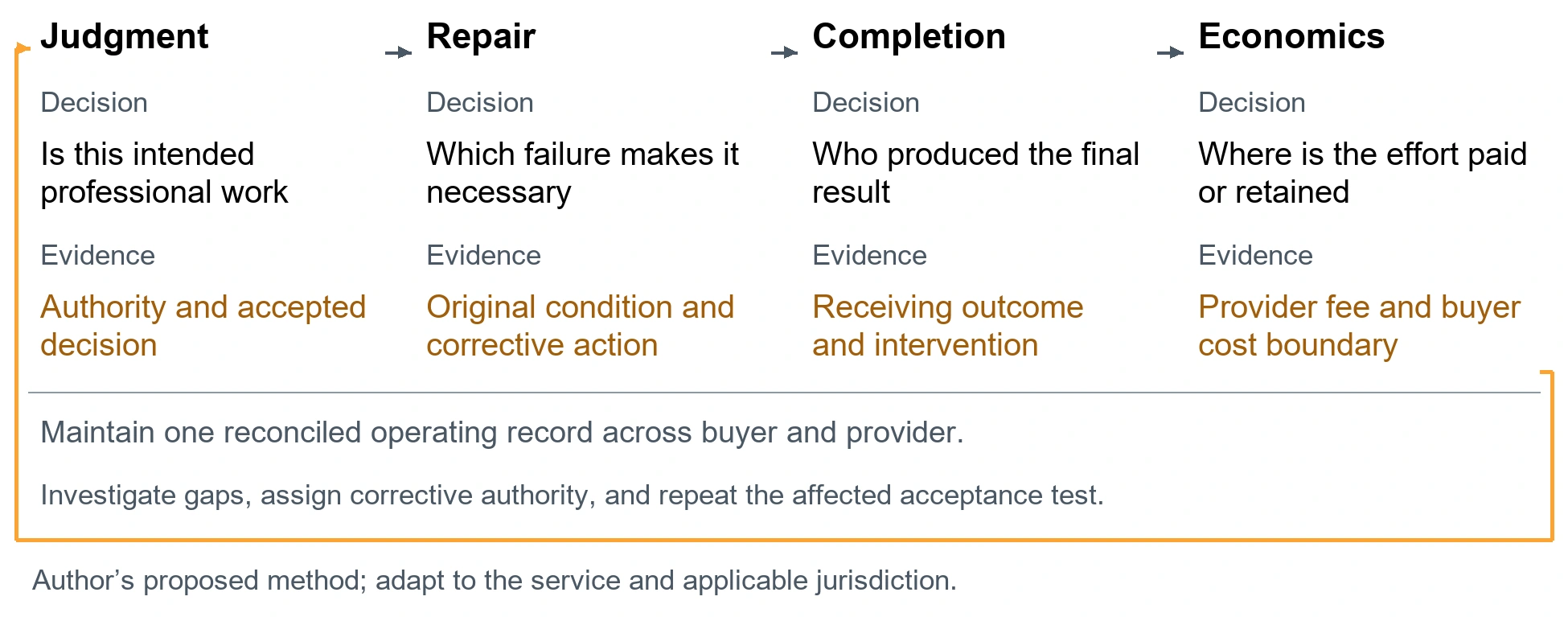
The executive sponsor should require management to identify the people, tasks, and judgment behind the automation claim. Human work may prepare inputs, repair access, resolve exceptions, verify outputs, complete actions, and correct reports. Some of that work is necessary and valuable. Its omission makes the service harder to govern and its economics harder to assess.
The study reports manual alteration across all 150 sampled engagements.1 This is a reported characteristic of the sample, not evidence that every automated service is uneconomic or that every intervention is misconduct. It should prompt investigation of the actual delivery method and its disclosed operating boundaries.
The first question is where the claimed automation starts and stops. A provider can automate a visible step while the buyer absorbs work before or after it. The executive approval should follow the complete purchased business outcome rather than the part of the process most convenient to measure.
A qualified person reviewing a consequential decision may be part of the intended service. Reentering data because an integration failed is a different activity. Changing a performance record so unfinished work appears complete is different again. Management should not group these actions into one undifferentiated manual-work total.
Stanford’s selected enterprise cases describe human oversight as a task-dependent operating choice.2 The executive should therefore ask which human contribution improves the outcome and which compensates for an unresolved defect. The appropriate objective may be a better hybrid service rather than the highest possible autonomy rate.
For a hypothetical claims-support service, an adjuster’s judgment on an unusual loss can be legitimate retained work, while repeated correction of a missing data field may be avoidable. The business case should count both, but the improvement plan should treat their causes differently.
Figure 1 proposes a record connecting human activity to purpose, authority, accepted result, and cost. Identify whether the work is included in the provider fee, retained by the buyer, or supplied by another party. The buyer expenditure view should avoid double counting provider labor already included in the invoice.
Collect evidence from case records, system events, time studies, operating interviews, and reconciliation. Do not assume a single source captures all effort. An intervention log can be incomplete, while a timesheet can show hours without explaining the case outcome. Use complementary evidence to understand the work.
PwC’s GBS analysis combines agent execution with human oversight and recommends considering costs beyond labor rates.3 The proposed outsourcing application is to make that combined operating model explicit before comparing price, quality, and performance.
The provider and buyer should agree how material human intervention is reported. Staff should not be penalized simply for revealing necessary work, nor rewarded for presenting assisted completion as unattended success. Independent sampling should examine apparently automated cases as well as labeled exceptions.
Management should investigate recurring causes: unclear authority, missing information, access delays, unsuitable tools, difficult judgment, or poor process design. Improvement should remove avoidable causes while retaining necessary capacity. A lower recorded intervention rate should be checked against actual case evidence.
EU, UK, Swiss, US, and other operations may differ in professional, privacy, employment, and service requirements. Those differences can change the human contribution needed. A global automation target should not erase a local duty or assume that qualified judgment can be removed without changing the service.
A reasonable objection is that exposing manual work may weaken a useful commercial proposition. It can also make the proposition more credible. A transparent hybrid service can offer better cost and quality than the predecessor even when people remain involved. The buyer needs that complete comparison rather than an unsupported claim of autonomy.
The executive should receive accepted outcomes, visible human contribution, complete buyer cost, recurring repair causes, and the improvement plan. Require service restrictions where necessary oversight or correction capacity is unavailable. Do not approve expansion on an automation percentage that cannot be reconciled to the work.
Human involvement should be governed as part of delivery. The executive decision is whether the service creates accepted value with its real mix of people and agents. That judgment becomes defensible when the work sustaining the result is visible, authorized, measured, and reflected in the commercial model.
The study is a nonrepresentative cross-section of 850 vendor delivery-team respondents on 150 engagements serving Tier 1 financial institutions, collected during January–June 2026. Neither banks nor vendors corroborated the accounts. It establishes reported experience, not causation, legal breach, or market prevalence. Its application here is a mechanism to investigate, not an estimate of conditions in other industries. The author-supplied version 1.8.2 is dated November 1, 2026 and is cited as a forthcoming manuscript consulted October 23, 2026.4
This is an analytical decision paper based on the supplied study and selected primary public sources checked through October 23, 2026. The original contribution is a human-contribution evidence record distinguishing necessary judgment, avoidable repair, manual completion, and the economic boundary behind an automation claim. The proposed method has not been independently validated. Legal requirements depend on the entity, activity, jurisdiction, and effective provisions; supervisory observations, research, and professional commentary have distinct authority.