# Ownership and Reuse of Agent Memory and Workflow IP

An Executive Decision on the Knowledge Created in Delivery

Author: Phil Hatch
Publisher: Akholi
Paper ID: AAO-046
Published: October 23, 2026
Language: en
Canonical: https://akholi.com/papers/ownership-and-reuse-of-agent-memory-and-workflow-ip/
Audience: General counsel, CIO and corporate strategy leader

Executives should allocate rights in the operational knowledge created by provider agents before it becomes embedded in the service. Input data, case memory, configurations, improvements, and reusable provider methods require distinct decisions about use, access, transfer, and protection.

<h2 id="section-1">Identify the Knowledge the Service Is Creating</h2>
<p>The executive sponsor should ask what the provider’s agent learns or preserves while performing the buyer’s work. The service may accumulate case history, customer preferences, exceptions, decision precedents, workflow instructions, and configurations. Those assets can determine how the service operates and how difficult it becomes to replace.</p>
<p>Morgan Lewis’s contracting analysis recommends explicit <a href="https://www.morganlewis.com/-/media/files/publication/outside-publication/article/2026/negotiating-ai-provisions-in-commercial-and-technology-contracts-where-the-market-is-heading-the-licensing-journal.pdf">treatment of output, training-data use, return, and deletion rights.</a><sup id="ref-1"><a href="#note-1" aria-label="Note 1">1</a></sup> The buyer should extend that assessment to the actual knowledge artifacts created in its delivery model. A general statement that the buyer owns its data does not necessarily settle use of configurations, derived context, or shared improvements.</p>
<p>Distinguish the buyer’s confidential material, third-party licensed content, provider background technology, and newly developed work. The parties may legitimately need different rights in each. The objective is a usable allocation that protects the buyer’s service and the provider’s lawful reusable capability, rather than an unsupported claim that everything belongs to one side.</p>
<h2 id="section-2">Separate Legal Ownership from Operating Access</h2>
<p>Ownership, permission to use, confidentiality, privacy, and technical portability are different questions. A buyer can own an artifact but lack the format, license, or expertise needed to operate it. A provider can possess information without permission to reuse it for another customer or model improvement.</p>
<p>The UK copyright report examines licensing and policy questions; it does <a href="https://www.gov.uk/government/publications/report-and-impact-assessment-on-copyright-and-artificial-intelligence/report-on-copyright-and-artificial-intelligence">not create a universal ownership rule for AI-generated material.</a><sup id="ref-2"><a href="#note-2" aria-label="Note 2">2</a></sup> EU, UK, Swiss, US, and other rights should be assessed for the specific artifact and contribution. Contractual allocation should not assume that copyright exists in every output or that a contract can grant rights held by someone else.</p>
<p>A hypothetical exception library may combine buyer procedures, provider-developed handling patterns, and licensed reference material. The rights schedule should distinguish those layers. The buyer needs continuity and investigation access, while reuse elsewhere must remain within the permissions and confidentiality applicable to each contribution.</p>
<h2 id="section-3">Use a Delivery Knowledge Rights Record</h2>
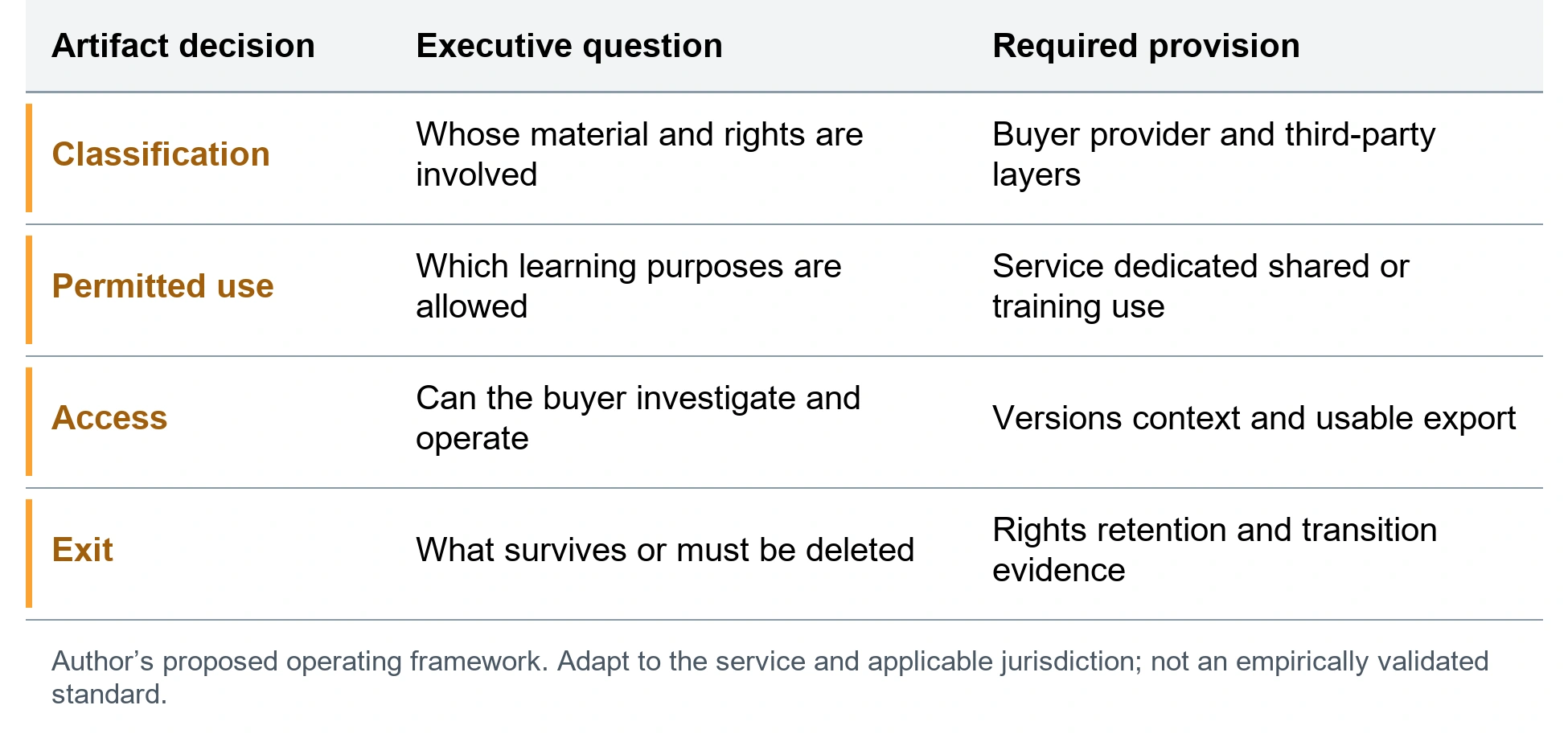
<p>Figure 1 proposes a record of artifact, permitted use, buyer access, and exit treatment. Identify where the information is stored, whether it is shared across customers, how it changes, and who can export or delete it. Include backups, retrieval indexes, and downstream copies where relevant.</p>
<p>The study’s <a href="https://akholi.com/outsourcing-2026-agentic-ai-tier-1-banks/part-4-delivery-workforce/">accounts</a> of operational knowledge held outside formal systems show why practical access deserves attention.<sup id="ref-3"><a href="#note-3" aria-label="Note 3">3</a></sup> They do not establish ownership of any agent memory or workflow. The buyer should investigate which knowledge its own service requires and whether the agreed rights reach the place where that knowledge resides.</p>
<p>State whether learning may be used only to perform the buyer’s service, to improve a dedicated configuration, to improve a shared product, or to train a broader model. These uses have different consequences. Consent to one should not silently authorize the others, particularly where confidential or personal information is involved.</p>
<figure><img loading="lazy" src="https://akholi.com/wp-content/uploads/2026/10/046-f1.webp" width="1950" height="918" alt="The delivery knowledge rights record. Classification; Whose material and rights are involved; Buyer provider and third-party layers. Permitted use; Which learning purposes are allowed; Service dedicated shared or training use. Access; Can the buyer investigate and operate; Versions context and usable export. Exit; What survives or must be deleted; Rights retention and transition evidence. Author’s proposed operating framework. Adapt to the service and applicable jurisdiction; not an empirically validated standard."><figcaption>Figure 1. The delivery knowledge rights record<small><a href="https://akholi.com/outsourcing-2026-agentic-ai-tier-1-banks/">Phil Hatch, proposed framework developed for this paper.</a></small></figcaption></figure>
<h2 id="section-4">Protect the Ability to Continue and Challenge the Service</h2>
<p>The buyer should secure the evidence and working context needed for investigation, correction, and transition. Test an export with representative artifacts and confirm that a qualified recipient can interpret it. A file containing embeddings or prompts may be insufficient without source references, versions, state, and necessary licenses.</p>
<p>For personal data, privacy specialists should assess purposes, roles, retention, lawful grounds, and individual rights separately from intellectual-property ownership. A permission to reuse a workflow does not automatically permit reuse of customer information embedded in its examples or memory.</p>
<p>The provider should identify background methods it intends to retain and any limitations on customer transfer. The buyer can then decide whether a license, documentation, transition assistance, or a different architecture addresses the dependence. An unexamined proprietary claim should not become a barrier discovered only at exit.</p>
<h2 id="section-5">Approve Rights Before Context Becomes Indispensable</h2>
<p>A reasonable objection is that allocating every future improvement is impossible. Define artifact categories, permitted purposes, default treatment, and a review route for material new forms of learning. The schedule should be updated as the service changes rather than attempt to predict every technical representation.</p>
<p>The executive should receive the rights map, unresolved third-party permissions, data-use restrictions, tested export, and continuity limitations. Reassess the decision when the provider introduces shared memory, a new training purpose, or a broader reuse claim. The service’s growing knowledge should remain governed as deliberately as its initial access.</p>
<p>The buyer should approve a relationship in which operational knowledge remains usable for the intended service and protected against unauthorized reuse. Ownership language matters, but access, lawful use, and transfer determine whether that language supports the business when the provider changes or the relationship ends.</p>
<h2 id="section-6">Evidence and Source Note</h2>
<p>The study is a nonrepresentative cross-section of 850 vendor delivery-team <a href="https://akholi.com/outsourcing-2026-agentic-ai-tier-1-banks/introduction/">respondents</a> on 150 engagements serving Tier 1 financial institutions, collected during January–June 2026. Neither banks nor vendors corroborated the accounts. It establishes reported experience, not causation, legal breach, or market prevalence. Its application here is a mechanism to investigate, not an estimate of conditions in other industries. The author-supplied version 1.8.2 is dated November 1, 2026 and is cited as a forthcoming manuscript consulted October 23, 2026.<sup id="ref-4"><a href="#note-4" aria-label="Note 4">4</a></sup></p>
<p>This is an analytical decision paper based on the supplied study and selected primary public sources checked through October 23, 2026. The original contribution is a delivery-knowledge rights record separating ownership, permitted learning, confidentiality, operating access, and usable transfer of agent memory and workflow artifacts. The proposed method has not been independently validated. Legal requirements depend on the entity, activity, jurisdiction, and effective provisions; supervisory observations, research, and professional commentary have distinct authority.</p>
<h2 id="notes">Notes</h2><ol class="akp-notes"><li id="note-1">Doneld Shelkey, “Negotiating AI Provisions in Commercial and Technology Contracts: Where the Market Is Heading,” The Licensing Journal, May 1, 2026, pp. 1–2, intellectual property and transition, <a href="https://www.morganlewis.com/-/media/files/publication/outside-publication/article/2026/negotiating-ai-provisions-in-commercial-and-technology-contracts-where-the-market-is-heading-the-licensing-journal.pdf">https://www.morganlewis.com/-/media/files/publication/outside-publication/article/2026/negotiating-ai-provisions-in-commercial-and-technology-contracts-where-the-market-is-heading-the-licensing-journal.pdf</a>. <a href="#ref-1" aria-label="Return to note 1">↩</a></li><li id="note-2">UK Department for Science Innovation and Technology Department for Culture Media and Sport and Intellectual Property Office, “Report on Copyright and Artificial Intelligence,” UK Department for Science Innovation and Technology Department for Culture Media and Sport and Intellectual Property Office, March 18, 2026, sections A and G; policy report, not a new ownership rule, <a href="https://www.gov.uk/government/publications/report-and-impact-assessment-on-copyright-and-artificial-intelligence/report-on-copyright-and-artificial-intelligence">https://www.gov.uk/government/publications/report-and-impact-assessment-on-copyright-and-artificial-intelligence/report-on-copyright-and-artificial-intelligence</a>. <a href="#ref-2" aria-label="Return to note 2">↩</a></li><li id="note-3">Phil Hatch, <i>Agentic AI Outsourcing at Tier 1 Financial Institutions: Full Study Report</i>, version 1.8.2 (Akholi, forthcoming manuscript dated November 1, 2026), Part 4, “Knowledge at Risk of Departure”, <a href="https://doi.org/10.2139/ssrn.7164559">https://doi.org/10.2139/ssrn.7164559</a>. <a href="#ref-3" aria-label="Return to note 3">↩</a></li><li id="note-4">Hatch, <i>Agentic AI Outsourcing</i>, Introduction, “Executive Summary” and “Evidentiary Basis and Its Limits”. <a href="#ref-4" aria-label="Return to note 4">↩</a></li></ol>
<h2 id="bibliography">Bibliography</h2><ul class="akp-bibliography"><li>Hatch, Phil. <i>Agentic AI Outsourcing at Tier 1 Financial Institutions: Full Study Report</i>. Version 1.8.2. Akholi. Forthcoming manuscript dated November 1, 2026. Author-supplied manuscript consulted October 23, 2026. <a href="https://doi.org/10.2139/ssrn.7164559">https://doi.org/10.2139/ssrn.7164559</a>.</li><li>Shelkey, Doneld. “Negotiating AI Provisions in Commercial and Technology Contracts: Where the Market Is Heading.” The Licensing Journal. May 1, 2026. <a href="https://www.morganlewis.com/-/media/files/publication/outside-publication/article/2026/negotiating-ai-provisions-in-commercial-and-technology-contracts-where-the-market-is-heading-the-licensing-journal.pdf">https://www.morganlewis.com/-/media/files/publication/outside-publication/article/2026/negotiating-ai-provisions-in-commercial-and-technology-contracts-where-the-market-is-heading-the-licensing-journal.pdf</a>.</li><li>UK Department for Science Innovation and Technology Department for Culture Media and Sport and Intellectual Property Office. “Report on Copyright and Artificial Intelligence.” UK Department for Science Innovation and Technology Department for Culture Media and Sport and Intellectual Property Office. March 18, 2026. <a href="https://www.gov.uk/government/publications/report-and-impact-assessment-on-copyright-and-artificial-intelligence/report-on-copyright-and-artificial-intelligence">https://www.gov.uk/government/publications/report-and-impact-assessment-on-copyright-and-artificial-intelligence/report-on-copyright-and-artificial-intelligence</a>.</li></ul>
