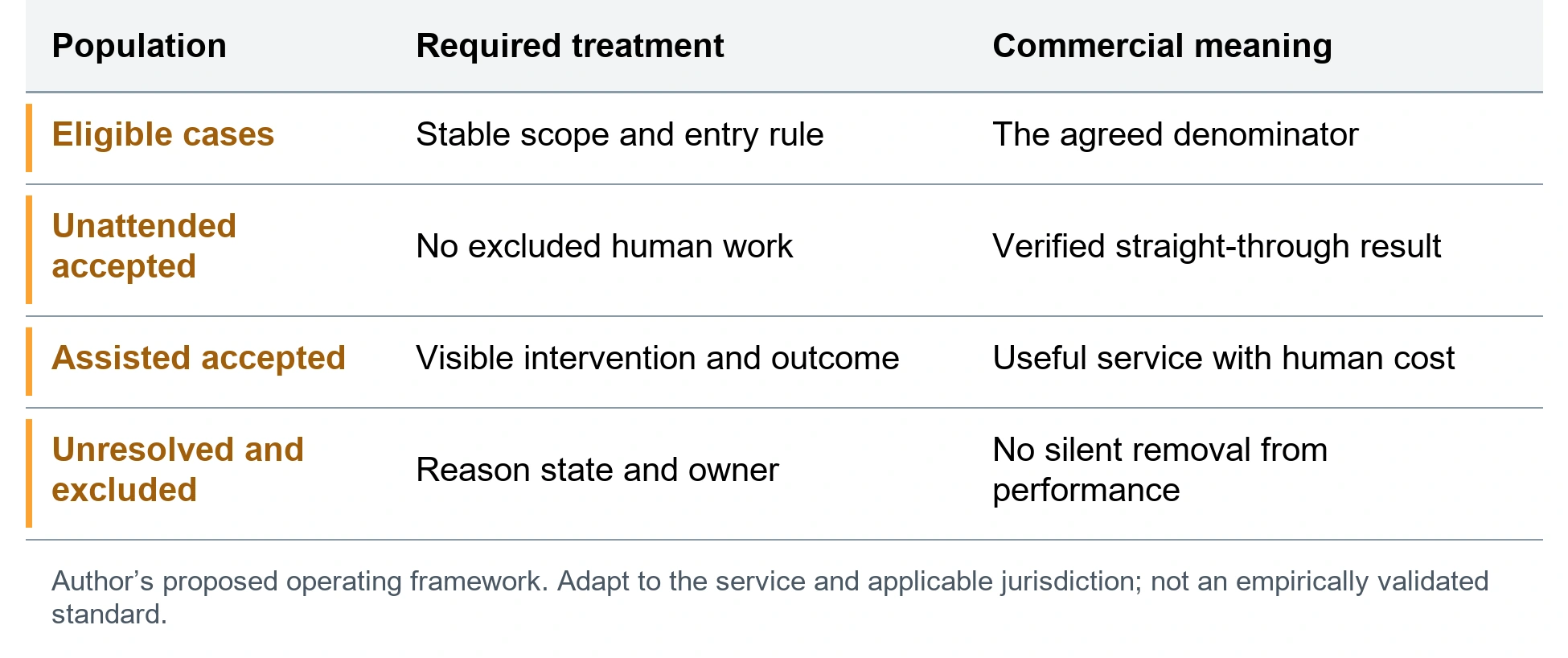
The sourcing manager should define where straight-through processing begins and ends before accepting the provider’s percentage. State the eligible workload, required outcome, period, systems, and treatment of exceptions. A provider can truthfully automate one step while the buyer still performs substantial work before or after it.
Bain’s provider analysis highlights the need for repeatable commercial models and measurable customer outcomes.1 The buyer should translate that principle into an auditable definition of unattended completion. A label such as touchless has little commercial meaning until both firms agree which human actions it excludes.
For a hypothetical invoice service, extraction and matching may be automatic while a buyer employee repairs supplier data and posts the final result. The manager should distinguish automated task completion from straight-through completion of the purchased invoice outcome. Both can be useful, but they support different pricing and value claims.
The study reports manual alteration across all sampled engagements and low reported discussion with banks in pooled disclosure answers.2 The finding does not establish the automation rate of another service. It supports testing whether the provider’s reported automation includes work that people perform outside the counted process boundary.
Define intervention categories: input repair, process change, output correction, manual completion, and reporting alteration where relevant to the study’s distinctions. Record the original state, action, authority, and final result. Legitimate human support should remain visible rather than be treated as evidence that the service has no value.
Reconcile intervention logs with case histories, tool records, returned work, and buyer operating effort. Include apparently successful automated cases in the review. Looking only at cases already labeled manual cannot detect the work omitted from that label.
Figure 1 proposes a reconciliation from eligible cases to accepted unattended outcomes. Separate failed, pending, abandoned, corrected, and excluded work. Document why a case is excluded and retain a stable eligibility rule. The provider should not improve the rate by removing difficult cases after the result is known.
An illustrative service might receive 1,000 eligible cases, complete 800 without human intervention, complete 150 with assistance, and leave 50 unresolved. On that defined boundary, unattended accepted completion is 80%, while total accepted completion is 95%. These are hypothetical figures demonstrating different measures, not study findings or a target.
A task-level rate should remain separate. If one case contains several automated tasks and one material human step, counting the tasks does not establish unattended case completion. The manager should select the unit that corresponds to the purchased outcome and show any supporting task measures as diagnostics.
McKinsey’s operating-economics analysis identifies refinement, orchestration, and other costs beyond model calls.3 The buyer should compare the automation measure with retained effort and accepted unit cost. A higher unattended rate is not automatically better if quality declines or costly exceptions move outside the supplier’s boundary.
Agree the evidence and reconciliation procedure for payment. State whether pricing follows attempted work, accepted work, or a verified autonomy level, and how later corrections affect the calculation. The contract should identify who resolves disputed classification and what records remain available for review.
Apply local privacy, employment, secrecy, and sector requirements to the evidence collected across EU, UK, Swiss, US, and other operations. The firms can protect sensitive details while preserving enough information to verify the commercial claim. A restriction on sharing should be addressed through a lawful assurance method rather than an unsupported percentage.
A reasonable objection is the effort of recording every small human touch. Define material intervention according to the purpose of the measure and preserve consistent categories. Automated event capture can reduce burden, while independent samples test whether the records are complete. Do not change the definition simply to make the rate easier to achieve.
Run the reconciliation over a representative period and investigate differences between provider reports and buyer evidence. Identify whether recurring interventions reflect defects, buyer prerequisites, necessary judgment, or an inaccurate commercial boundary. Use the findings to improve delivery and revise the price basis where appropriate.
The manager should pay for the level of automation the complete case evidence supports. A credible straight-through claim makes human work, unresolved cases, and exclusions visible. That clarity gives both firms a better basis for improving the service than a high percentage whose denominator and process boundary cannot be explained.
The study is a nonrepresentative cross-section of 850 vendor delivery-team respondents on 150 engagements serving Tier 1 financial institutions, collected during January–June 2026. Neither banks nor vendors corroborated the accounts. It establishes reported experience, not causation, legal breach, or market prevalence. Its application here is a mechanism to investigate, not an estimate of conditions in other industries. The author-supplied version 1.8.2 is dated November 1, 2026 and is cited as a forthcoming manuscript consulted October 23, 2026.4
This is an analytical decision paper based on the supplied study and selected primary public sources checked through October 23, 2026. The original contribution is a case-based straight-through-processing reconciliation separating eligibility, unattended acceptance, assisted completion, unresolved work, and task-level automation claims. The proposed method has not been independently validated. Legal requirements depend on the entity, activity, jurisdiction, and effective provisions; supervisory observations, research, and professional commentary have distinct authority.