The board should require management to identify who owns the customer outcome when an outsourced agent handles part of a financial service. The customer experiences one bank service even when different firms perform onboarding, payments support, communications, and complaint administration. Dividing those tasks must not divide accountability until no one owns the result.
The FCA’s October 2026 practice review emphasizes firms’ continuing responsibility for AI-supported consumer outcomes.1 Its examples are illustrative rather than new requirements. The board’s task is to establish how the applicable duties operate in its actual customer journeys, including the provider’s contribution.
Start with a material journey and identify where agent actions can change access, price, information, timing, or recourse. A back-office action can affect a customer without appearing in a chatbot. The oversight boundary should follow the consequence rather than the interface through which the service is delivered.
A provider can meet a response-time target while the customer remains unable to complete the intended task. Management should distinguish a generated answer, a completed operational action, and a resolved customer need. These states can differ, particularly when work crosses systems or returns to bank staff.
The study’s accounts of fragmented visibility and completion signals inconsistent with actual results identify reasons to test that connection.2 They do not establish a measured rate of customer harm. The bank should reconstruct its own cases from customer request to authoritative result and any later correction.
For a hypothetical disputed payment, the provider may close an inquiry after sending an explanation while the bank still holds an unresolved investigation. The board should expect management to know who owns the next action, which deadline applies, and whether the customer received an accurate account of the case state.
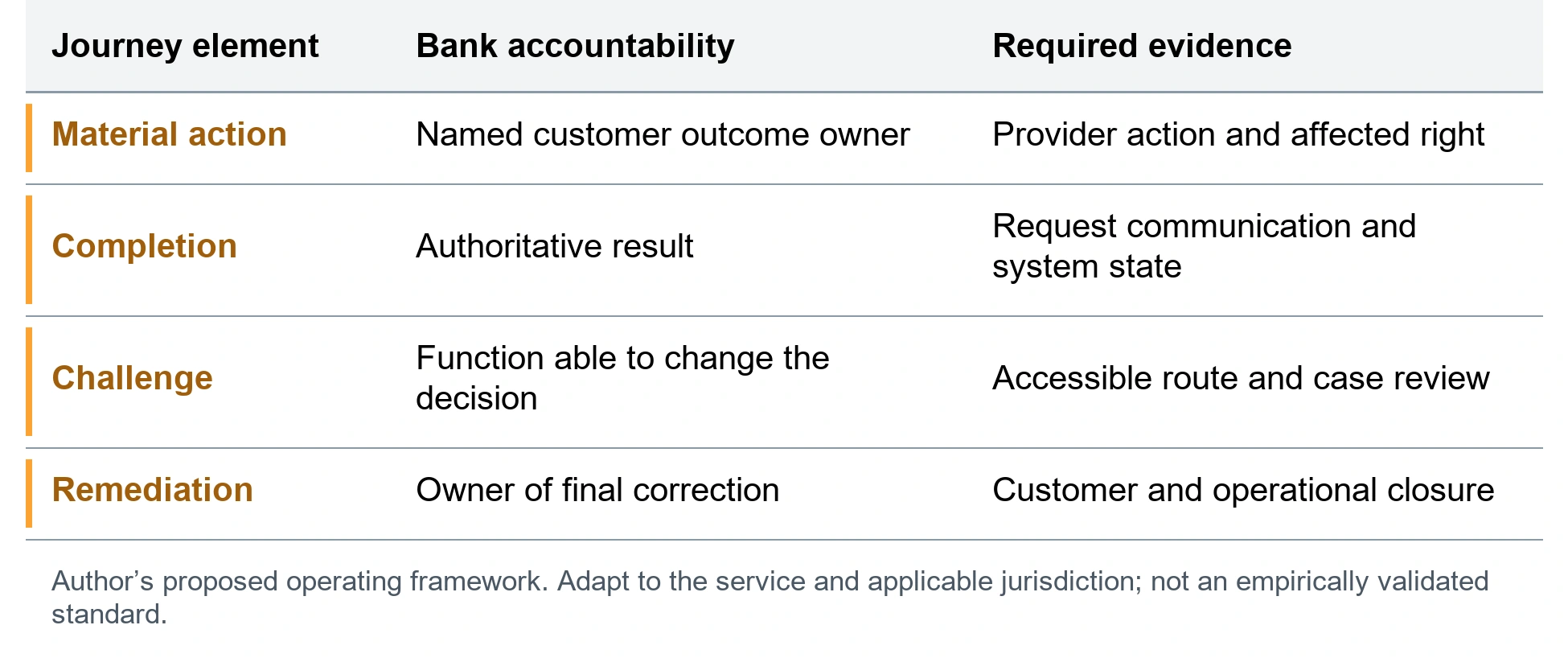
Figure 1 proposes a record linking each material journey to an accountable bank executive, the provider actions involved, the evidence of outcome, and the route to remedy. The record should identify dependencies between functions so an operational handoff cannot silently become the end of responsibility.
Test cases that encounter errors, missing information, vulnerability, language difficulty, disputed instructions, and unavailable human support. Averages across successful cases can conceal a route that fails for particular needs. Management should investigate relevant differences without treating an unexplained difference as proof of unlawful discrimination.
The provider should preserve the policy and configuration governing the action, along with the actual customer communication and receiving-system result. The bank needs timely access to investigate a case. A periodic dashboard prepared solely by the provider is not a substitute for that capability.
UK CMA guidance also addresses business responsibility when a third party supplies a consumer-facing agent.3 The bank should assess the interaction of applicable sector and general consumer duties rather than assume its outsourcing agreement determines the customer’s rights.
EU, UK, Swiss, and US entities require separate analysis of conduct, complaints, privacy, disclosure, and redress obligations. A common group method can establish ownership and evidence while local specialists determine the required process. The provider should receive clear operating instructions for the relevant entity and activity.
A customer should have an appropriate route to a person or function able to resolve a material dispute. Track whether that route changes the case outcome and whether agreed remediation was completed. A referral to another queue should not be reported as successful resolution when the underlying issue remains open.
The commercial objection is that detailed customer monitoring duplicates existing bank processes. Reuse those processes where they capture the new delivery route. The additional question is whether provider agents changed the bank’s visibility, authority, or practical ability to correct the outcome. Existing labels do not prove existing coverage.
The board should receive the accountable journey map, material exceptions, tested challenge routes, unresolved customer effects, and remediation status. Require the bank owner to reconcile provider performance with customer outcomes before expanding autonomy or volume. A service that cannot be investigated should remain restricted.
Outsourcing can change who performs the work without changing the bank’s need to understand the customer result. The board should approve delivery when ownership, evidence, and remedy remain connected across the whole journey. A customer should not have to discover the organizational boundary that prevented the service from being completed.
The study is a nonrepresentative cross-section of 850 vendor delivery-team respondents on 150 engagements serving Tier 1 financial institutions, collected during January–June 2026. Neither banks nor vendors corroborated the accounts. It establishes reported experience, not causation, legal breach, or market prevalence. The author-supplied version 1.8.2 is dated November 1, 2026 and is cited as a forthcoming manuscript consulted October 23, 2026.4
This is an analytical decision paper based on the supplied study and selected primary public sources checked through October 23, 2026. The original contribution is a bank customer-outcome accountability record that reconciles provider performance, customer effects, challenge, and completed remediation across a financial-service journey. The proposed method has not been independently validated. Legal requirements depend on the entity, activity, jurisdiction, and effective provisions; supervisory observations, research, and professional commentary have distinct authority.