# Keep Adverse Event Case Clocks Visible in AI-Enabled Outsourcing

A Joint Pharmacovigilance Timing Method

Author: Phil Hatch
Publisher: Akholi
Paper ID: AAO-037
Published: October 23, 2026
Language: en
Canonical: https://akholi.com/papers/keep-adverse-event-case-clocks-visible-in-ai-enabled-outsourcing/
Audience: Pharmacovigilance outsourcing manager, safety operations lead, vendor quality manager

Pharmacovigilance managers should preserve the relevant initial receipt and awareness evidence across every supplier handoff. An internal transfer or agent-processing event must not silently replace the event that starts the applicable safety-reporting clock.

<h2 id="section-1">Preserve the Event That Starts the Obligation</h2>
<p>The pharmacovigilance operations manager should agree how the outsourced service identifies, timestamps, transfers, and escalates potential safety information. The governing clock depends on the applicable reporting rules and case circumstances. The supplier’s processing start is not automatically the legally relevant starting event.</p>
<p>EMA GVP Module VI <a href="https://www.ema.europa.eu/en/documents/regulatory-procedural-guideline/guideline-good-pharmacovigilance-practices-gvp-module-vi-collection-management-submission-reports-suspected-adverse-reactions-medicinal-products-rev-2_en.pdf">addresses initial awareness, contractors, and explicit safety-information exchange agreements.</a><sup id="ref-1"><a href="#note-1" aria-label="Note 1">1</a></sup> The manager should translate the applicable provisions into a case record that survives agent extraction, supplier review, and transfer to the sponsor. A fresh internal case number should not erase earlier receipt evidence.</p>
<p>Define the sources the service monitors, the minimum information assessed, the responsible safety function, and the route for uncertain cases. The agent should preserve the original material and identify what it extracted or inferred. Missing information should prompt the agreed follow-up or escalation, not an invented fact that makes the case appear complete.</p>
<h2 id="section-2">Separate Receipt from Processing Milestones</h2>
<p>Use distinct fields for source receipt, relevant awareness assessment, supplier intake, human review, sponsor receipt, submission, and acknowledgment. Preserve time zone and provenance where timing matters. These events describe different parts of the service and should not overwrite one another.</p>
<p>The <a href="https://akholi.com/outsourcing-2026-agentic-ai-tier-1-banks/part-2-five-failure-categories/">study</a>’s fragmented visibility and delayed joint decisions provide a <a href="https://akholi.com/outsourcing-2026-agentic-ai-tier-1-banks/part-2-five-failure-categories/">transferable warning about handoffs, not evidence of pharmacovigilance breach.</a><sup id="ref-2"><a href="#note-2" aria-label="Note 2">2</a></sup> Managers should test whether the safety workflow preserves the governing event when the case moves between systems and organizations.</p>
<p>For a hypothetical literature case, the supplier may identify relevant information during a search but send a collated batch later. The operating record should preserve the applicable initial awareness evidence and the later transfer separately. The safety specialist should determine the governing date under the actual rules, rather than let a batch-export timestamp decide it.</p>
<h2 id="section-3">Use One Clock Record Across the Supplier Chain</h2>
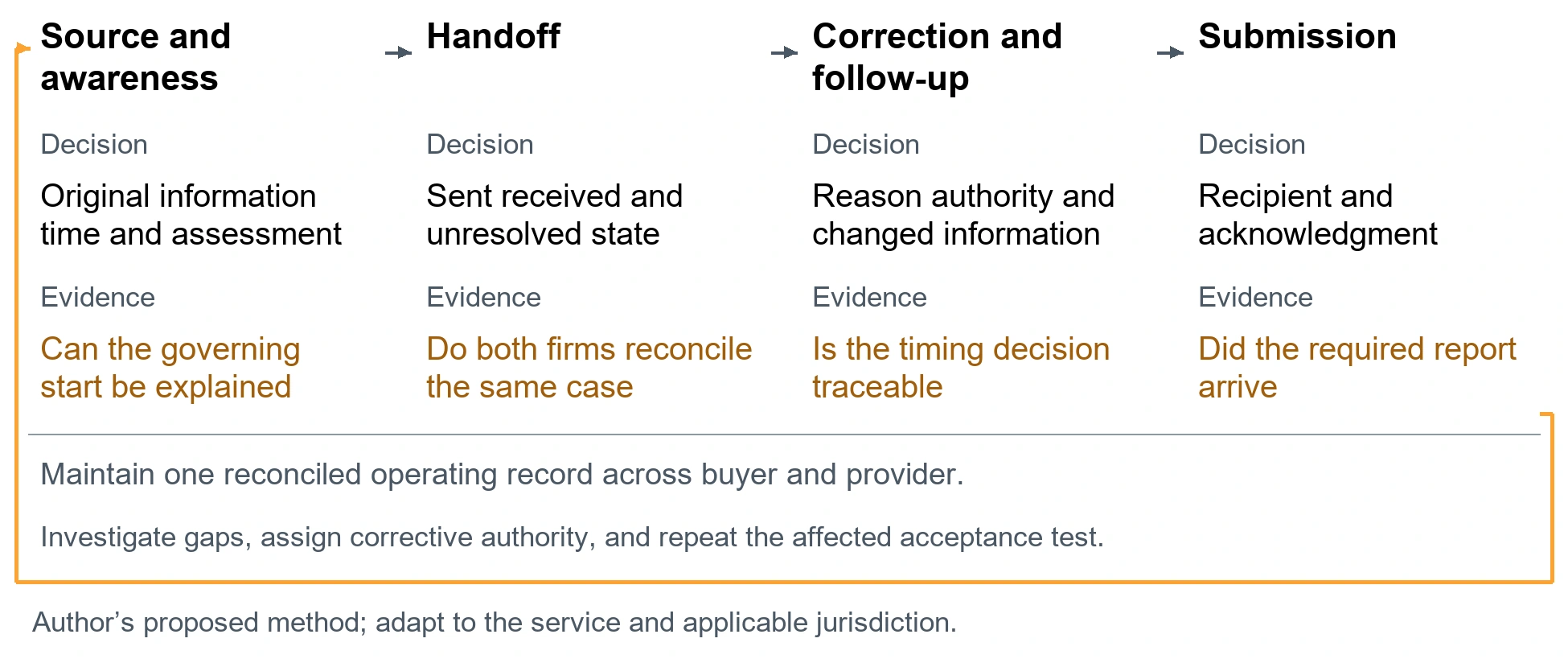
<p>Figure 1 proposes a joint record of source event, assessed clock, handoffs, and final submission. Assign an owner for each unresolved timing question. The record should identify the rule and version used, the reason for the selected start event, the required next action, and the evidence showing that the receiving party accepted the case.</p>
<p>Test weekends, time-zone differences, duplicate reports, incomplete cases, follow-up information, failed transfers, and downstream subcontractors. A case should remain visible while its classification is disputed. A supplier should not pause an externally governed obligation simply by assigning an internal status of awaiting clarification.</p>
<p>The sponsor and supplier should reconcile open work frequently enough for the relevant deadlines. Compare both directions: cases sent but not received, and received cases not present in the sender’s completion record. Include failed acknowledgments and rejected submissions. A successful generation event does not establish successful regulatory transmission.</p>
<figure><img loading="lazy" src="https://akholi.com/wp-content/uploads/2026/10/037-f1.webp" width="1950" height="819" alt="The joint safety case clock record. Source and awareness. Decision: Original information time and assessment. Evidence: Can the governing start be explained. Handoff. Decision: Sent received and unresolved state. Evidence: Do both firms reconcile the same case. Correction and follow-up. Decision: Reason authority and changed information. Evidence: Is the timing decision traceable. Submission. Decision: Recipient and acknowledgment. Evidence: Did the required report arrive. Maintain one reconciled operating record across buyer and provider.. Investigate gaps, assign corrective authority, and repeat the affected acceptance test.. Author’s proposed method; adapt to the service and applicable jurisdiction."><figcaption>Figure 1. The joint safety case clock record<small><a href="https://akholi.com/outsourcing-2026-agentic-ai-tier-1-banks/">Phil Hatch, proposed framework developed for this paper.</a></small></figcaption></figure>
<h2 id="section-4">Maintain Current Rules and Traceable Corrections</h2>
<p>EMA’s current GVP page notes applicable implementing amendments and <a href="https://www.ema.europa.eu/en/human-regulatory-overview/post-authorisation/pharmacovigilance-post-authorisation/good-pharmacovigilance-practices-gvp">interim use of relevant ICH updates pending module revisions.</a><sup id="ref-3"><a href="#note-3" aria-label="Note 3">3</a></sup> Managers should not treat an older module PDF as the complete current rule set. The qualified safety and regulatory functions should maintain the local applicability and version decisions.</p>
<p>EU, UK, Swiss, and US safety-reporting routes and requirements must be assessed separately. The joint technical record can be common, but case validity, seriousness, follow-up, timing, and recipient decisions need the applicable rules. A single global SLA should support those obligations rather than substitute for them.</p>
<p>Human corrections must preserve the original classification, revised decision, reason, authority, and time. Distinguish new significant information from correction of a processing mistake. The responsible safety function should decide the effect on reporting, while the provider preserves the evidence required to explain the sequence.</p>
<h2 id="section-5">Accept Timing Through Reconciled Cases</h2>
<p>A reasonable concern is that duplicate timestamps and records create complexity. The solution is one controlled event model with clear meanings, not one ambiguous date. Automate event capture where reliable and preserve a route for specialists to resolve conflicting evidence. The service should make the obligation easier to see.</p>
<p>Before production acceptance, reconstruct representative cases from source to acknowledged submission. Include a delayed supplier transfer and an agent extraction error. Record where the clock became uncertain, assign corrections, and repeat the affected test. Do not approve the service solely on average processing speed.</p>
<p>The manager should require evidence that the relevant safety clock remains visible throughout the two-party workflow. A case is not controlled merely because it moved quickly inside one supplier system. It is controlled when the applicable obligation, remaining time, responsible owner, and submission state can be established across the full chain.</p>
<h2 id="section-6">Evidence and Source Note</h2>
<p>The study is a nonrepresentative cross-section of 850 vendor delivery-team <a href="https://akholi.com/outsourcing-2026-agentic-ai-tier-1-banks/introduction/">respondents</a> on 150 engagements serving Tier 1 financial institutions, collected during January–June 2026. Neither banks nor vendors corroborated the accounts. It establishes reported experience, not causation, legal breach, or market prevalence. Its application here is a mechanism to investigate, not an estimate of conditions in other industries. The author-supplied version 1.8.2 is dated November 1, 2026 and is cited as a forthcoming manuscript consulted October 23, 2026.<sup id="ref-4"><a href="#note-4" aria-label="Note 4">4</a></sup></p>
<p>This is an analytical decision paper based on the supplied study and selected primary public sources checked through October 23, 2026. The original contribution is a joint pharmacovigilance clock record that preserves source awareness, supplier handoffs, corrections, and acknowledged submission without substituting internal SLA events for applicable reporting rules. The proposed method has not been independently validated. Legal requirements depend on the entity, activity, jurisdiction, and effective provisions; supervisory observations, research, and professional commentary have distinct authority.</p>
<h2 id="notes">Notes</h2><ol class="akp-notes"><li id="note-1">European Medicines Agency and Heads of Medicines Agencies, <i>Guideline on Good Pharmacovigilance Practices (GVP): Module VI—Collection, Management and Submission of Reports of Suspected Adverse Reactions to Medicinal Products,</i> European Medicines Agency and Heads of Medicines Agencies, July 28, 2017, Rev. 2, VI.B.7 and VI.App.2.7–2.9, <a href="https://www.ema.europa.eu/en/documents/regulatory-procedural-guideline/guideline-good-pharmacovigilance-practices-gvp-module-vi-collection-management-submission-reports-suspected-adverse-reactions-medicinal-products-rev-2_en.pdf">https://www.ema.europa.eu/en/documents/regulatory-procedural-guideline/guideline-good-pharmacovigilance-practices-gvp-module-vi-collection-management-submission-reports-suspected-adverse-reactions-medicinal-products-rev-2_en.pdf</a>. <a href="#ref-1" aria-label="Return to note 1">↩</a></li><li id="note-2">Phil Hatch, <i>Agentic AI Outsourcing at Tier 1 Financial Institutions: Full Study Report</i>, version 1.8.2 (Akholi, forthcoming manuscript dated November 1, 2026), Part 2, sec. 5.1, “Agent Actions Visible Only Inside Each Firm’s Own Tools”, <a href="https://doi.org/10.2139/ssrn.7164559">https://doi.org/10.2139/ssrn.7164559</a>; Hatch, <i>Agentic AI Outsourcing</i>, Part 2, sec. 5.2, “Joint Decision Speed Mismatched to Agent Speed”. <a href="#ref-2" aria-label="Return to note 2">↩</a></li><li id="note-3">European Medicines Agency, “Good Pharmacovigilance Practices (GVP),” European Medicines Agency, accessed October 23, 2026, “Planned updates” and current module list, <a href="https://www.ema.europa.eu/en/human-regulatory-overview/post-authorisation/pharmacovigilance-post-authorisation/good-pharmacovigilance-practices-gvp">https://www.ema.europa.eu/en/human-regulatory-overview/post-authorisation/pharmacovigilance-post-authorisation/good-pharmacovigilance-practices-gvp</a>. <a href="#ref-3" aria-label="Return to note 3">↩</a></li><li id="note-4">Hatch, <i>Agentic AI Outsourcing</i>, Introduction, “Executive Summary” and “Evidentiary Basis and Its Limits”. <a href="#ref-4" aria-label="Return to note 4">↩</a></li></ol>
<h2 id="bibliography">Bibliography</h2><ul class="akp-bibliography"><li>European Medicines Agency. “Good Pharmacovigilance Practices (GVP).” European Medicines Agency. Accessed October 23, 2026. <a href="https://www.ema.europa.eu/en/human-regulatory-overview/post-authorisation/pharmacovigilance-post-authorisation/good-pharmacovigilance-practices-gvp">https://www.ema.europa.eu/en/human-regulatory-overview/post-authorisation/pharmacovigilance-post-authorisation/good-pharmacovigilance-practices-gvp</a>.</li><li>European Medicines Agency and Heads of Medicines Agencies. <i>Guideline on Good Pharmacovigilance Practices (GVP): Module VI—Collection, Management and Submission of Reports of Suspected Adverse Reactions to Medicinal Products.</i> European Medicines Agency and Heads of Medicines Agencies. July 28, 2017. <a href="https://www.ema.europa.eu/en/documents/regulatory-procedural-guideline/guideline-good-pharmacovigilance-practices-gvp-module-vi-collection-management-submission-reports-suspected-adverse-reactions-medicinal-products-rev-2_en.pdf">https://www.ema.europa.eu/en/documents/regulatory-procedural-guideline/guideline-good-pharmacovigilance-practices-gvp-module-vi-collection-management-submission-reports-suspected-adverse-reactions-medicinal-products-rev-2_en.pdf</a>.</li><li>Hatch, Phil. <i>Agentic AI Outsourcing at Tier 1 Financial Institutions: Full Study Report</i>. Version 1.8.2. Akholi. Forthcoming manuscript dated November 1, 2026. Author-supplied manuscript consulted October 23, 2026. <a href="https://doi.org/10.2139/ssrn.7164559">https://doi.org/10.2139/ssrn.7164559</a>.</li></ul>
