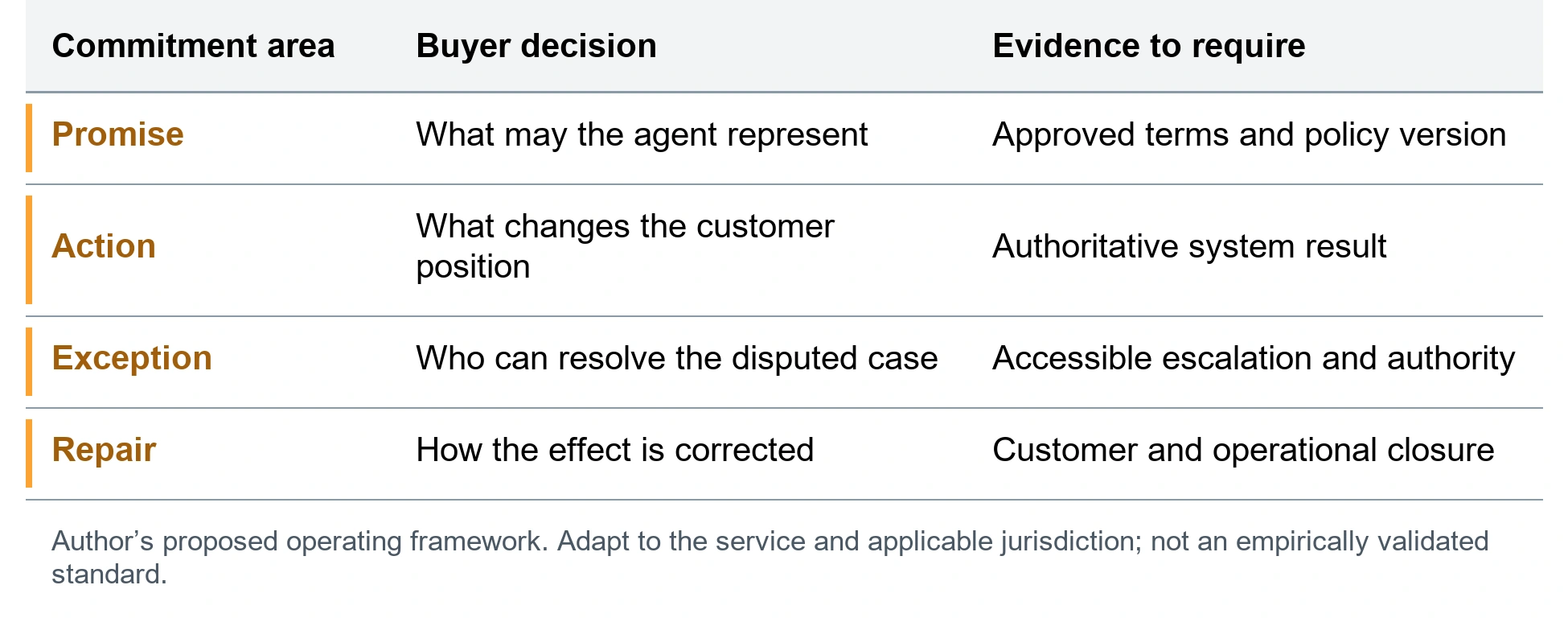
The executive responsible for the customer relationship should identify which commitments the outsourced agent can create or communicate. Refunds, renewals, prices, delivery dates, eligibility explanations, and complaint responses can affect a customer’s rights or decisions. They should not be treated as ordinary text generation merely because the action begins in a conversation.
UK CMA guidance states that consumer-law responsibility remains with the business when an outside provider supplies its agent.1 That UK position does not establish the law everywhere. It does demonstrate why the buyer must assess customer-facing authority independently of the allocation of costs and liability in its supplier agreement.
The immediate executive question is whether management can show what the provider is allowed to say and do on the buyer’s behalf, how policy reaches the service, and what happens when the agent creates an incorrect commitment. A promise of platform uptime does not answer those questions.
Create a record of material customer interactions and their downstream consequences. Distinguish providing information, recommending an option, changing a contract, accepting a request, and confirming completion. An agent can create a misleading impression if its words describe a result that the operational system has not accepted.
The study’s reported mismatch between tool success messages and actual completion identifies a mechanism relevant to customer service.2 It does not measure customer harm across industries. The buyer should test its own service by comparing the message received by the customer with the authoritative case, account, or transaction state.
For a hypothetical cancellation request, a friendly confirmation may reach the customer while the subscription remains active. The buyer should establish who owns the unresolved cancellation, whether further charging must be restricted, and how the customer is informed. The provider cannot close the case solely because the conversational exchange ended.
Figure 1 proposes a register linking each commitment to policy authority, enforcement, and repair. Define permitted terms, monetary or service limits, required information, reserved decisions, and escalation triggers. The register should identify which systems determine the authoritative result and which wording may be used before that result is confirmed.
Test realistic variations, including incomplete information, vulnerable customers, complaints, conflicting instructions, and attempts to obtain an unauthorized exception. The objective is not perfect wording on a curated script. It is evidence that the service preserves the relevant customer right and reaches an appropriate decision route when the normal path fails.
The service owner should control policy changes. A new price, cancellation rule, entitlement, or complaint process must reach the provider’s knowledge sources, tools, and operating staff. Retain the policy version governing the interaction so a later dispute can be assessed against what the service was authorized to offer at that time.
Mayer Brown’s agentic-contract analysis addresses outcome-based performance and the consequences of autonomous actions.3 The buyer should require prompt evidence and cooperation when a customer-facing action is disputed. A contractual indemnity may address cost recovery, but it does not by itself contact the customer, correct a bill, or restore a missed service.
EU, UK, Swiss, and US operations need local assessment of consumer, sector, privacy, accessibility, and contract duties. A common customer-service policy can provide a group baseline while local conditions determine notices, consent, records, escalation, and remedies. The provider should not infer that an English-language script is sufficient for every market.
Assign authority for urgent correction and preserve a route to a person able to resolve the issue. Repeating the same automated exchange is not meaningful escalation if the service lacks authority to address the disputed commitment. Track the case through the final customer outcome, including any remaining uncertainty.
An objection is that customer commitments are already covered by existing service controls. Where those controls operate across the provider’s agent, reuse them. The additional test is whether changing the delivery method altered who can make a promise, what evidence confirms it, and how a customer can obtain correction. Existing policy is useful only if the new service follows it.
The executive review should show material commitment types, observed exceptions, unresolved customer effects, policy-change coverage, and tested repair routes. A satisfaction score can supplement that evidence but should not conceal cases in which the promised action never occurred. Sample both complaints and apparently successful interactions.
The buyer should approve provider agents only within a customer mandate it can substantiate. Authority to speak for the business should remain connected to authority to act, and both should remain connected to the customer outcome. Outsourcing execution does not remove the executive need to know what the business has promised.
The study is a nonrepresentative cross-section of 850 vendor delivery-team respondents on 150 engagements serving Tier 1 financial institutions, collected during January–June 2026. Neither banks nor vendors corroborated the accounts. It establishes reported experience, not causation, legal breach, or market prevalence. Its application here is a mechanism to investigate, not an estimate of conditions in other industries. The author-supplied version 1.8.2 is dated November 1, 2026 and is cited as a forthcoming manuscript consulted October 23, 2026.4
This is an analytical decision paper based on the supplied study and selected primary public sources checked through October 23, 2026. The original contribution is a customer commitment register connecting provider speech, delegated action, policy versions, authoritative outcomes, and repair authority. The proposed method has not been independently validated. Legal requirements depend on the entity, activity, jurisdiction, and effective provisions; supervisory observations, research, and professional commentary have distinct authority.