The provider account leader should separate the performance of the service from the appearance of autonomy. A team that repairs a failed agent action may protect the bank while revealing an important weakness. If its evaluation treats the repair itself as failure, staff have a reason to avoid recording the work that management needs to see.
This is an incentive risk to examine, not a finding that the study established deliberate concealment. The study reports manual alteration across all 150 sampled engagements. Separately, 13 of 1,004 pooled valid answers to three bank-disclosure questions reported discussion with the institution. Those answers may repeat respondents and do not establish what the bank knew.1
The provider should investigate the conditions under which staff report intervention, managers classify it, and the bank receives material information. The objective is a reliable operating record. More reported intervention can initially indicate better observation rather than worse service, so a raw increase should not automatically trigger a negative performance judgment.
Bain’s provider analysis connects AI growth with changes in delivery, pricing, and talent models.2 A correction to an input, a change to a process, and an alteration of a performance report require different treatment. Authorized human repair may be part of the agreed service. A departure from an approval condition may require escalation. Changing the record so that incomplete work appears complete undermines the evidence used to judge delivery.
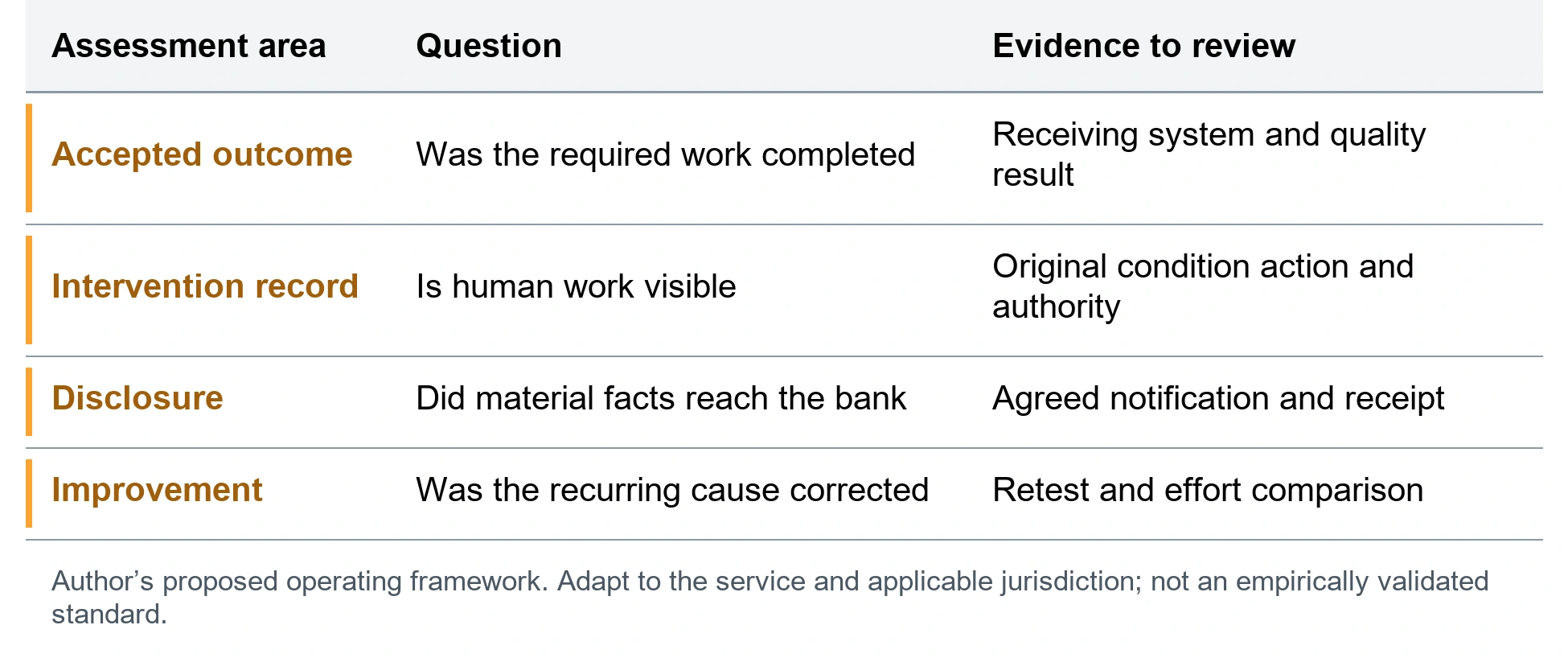
The provider and bank should agree categories, materiality, and notification routes. Staff should record the original condition, intervention, authority, reason, affected outcome, and evidence of completion. A manager should not replace that record with a single automation percentage that cannot distinguish the underlying cases.
Mayer Brown’s services-contract analysis addresses incentives, operational performance, and governance obligations for agentic delivery.3 Applied here, the operating agreement should make room for authorized human work while preserving the bank’s access to consequential deviations. A commercial promise of autonomy should not contradict the process that keeps the service reliable.
Figure 1 proposes an assessment that separates outcome quality from evidence quality. Evaluate whether the work met its acceptance standard, then whether the intervention record was complete and timely. A successfully repaired case can pass the outcome assessment while remaining an automation exception. An undisclosed repair should not become an unattended success.
The provider should assess whether teams surface recurring causes, cooperate with investigation, and verify fixes. Do not reward a simple count of reported incidents, which can encourage duplicate or low-value entries. Reward the completeness and usefulness of the evidence, with independent sampling to test whether material cases are missing.
A hypothetical team may discover that agents fail when a buyer field is absent. Staff can continue through an approved manual route while the two firms correct the input dependency. The performance record should show accepted work, human effort, and the open root cause. Removing the intervention from the report would make the cost and reliability of the proposed automation harder to assess.
The account leader should give staff a clear route to report material concerns outside the immediate delivery target. That route needs a defined recipient, confidentiality appropriate to the issue, and protection against retaliation under applicable policy and law. It should not promise immunity for misconduct or prevent proportionate investigation of an event.
Use independent assurance to compare intervention logs with case histories, time records, tool actions, and customer outcomes. The sample should include apparently successful unattended cases, not only cases already labeled exceptions. Discrepancies should lead to fact-finding before conclusions about motive or responsibility.
Bank secrecy, privacy, employee rights, and reporting obligations differ across Switzerland, the UK, the EU, and the US. The firms should agree which details can be shared, how sensitive records are protected, and who makes legally required notifications. Commercial confidentiality must not be used as a substitute for that analysis.
A reasonable concern is that more reporting will create an administrative burden and discourage useful corrections. Keep the record proportional to consequence and reuse system evidence where possible. Routine authorized support can be aggregated, while material deviations need prompt case-level attention. The distinction should be agreed before incentives are applied.
Review recurring interventions with the bank process owner. Separate provider defects, buyer prerequisites, unclear instructions, tool limitations, and necessary professional judgment. Fund changes that remove avoidable work, and price legitimate retained work honestly. A fall in intervention counts should be checked against evidence that the cause was resolved rather than merely relabeled.
The provider’s leadership mandate should be explicit: protect the outcome, preserve the evidence, and disclose material departures through the agreed route. Evaluate account performance on that basis. Transparent human work gives both firms a sounder foundation for improving the service than an automation claim that cannot survive case reconstruction.
The study is a nonrepresentative cross-section of 850 vendor delivery-team respondents on 150 engagements serving Tier 1 financial institutions, collected during January–June 2026. Neither banks nor vendors corroborated the accounts. It establishes reported experience, not causation, legal breach, or market prevalence. The author-supplied version 1.8.2 is dated November 1, 2026 and is cited as a forthcoming manuscript consulted October 23, 2026.4
This is an analytical decision paper based on the supplied study and selected primary public sources checked through October 23, 2026. The original contribution is a provider performance design that separately evaluates accepted outcomes, intervention evidence, material disclosure, and verified improvement without inferring motives from survey reports. The proposed method has not been independently validated. Legal requirements depend on the entity, activity, jurisdiction, and effective provisions; supervisory observations, research, and professional commentary have distinct authority.